Saltwater

  • Wonderland Echinata

    General information In the wild, Wonderland Echinata comes in two forms: either encrusting or massive. Their colonies may reach over a meter in length. They have circular corallites with thick walls and septa that have long and pointed teeth. Their skeleton is covered with a dense, fleshy tissue that usually forms a concentric fold. For the…

  • Limb of the Sun Favia

    General information In general, the genus Favia have large coral colonies that are circular in shape and comes in the form of massive, submassive and encrusting type. At a first glance, you can mistakenly identify Favia with Favites. However, with a closer look, Favia and Favites can easily be differentiated. Favites have corallite walls that…

  • Orange Eye Fungia

    General information In general, corals coming from the genus Fungia are solitary animals. Unlike your typical coral, Fungia coral is not composed of a colony, but instead, is a  single-polyp coral. It has a flattened skeletal structure that resembles like a disc. Its corallite walls are highly elevated forming plates and their mouth is located…

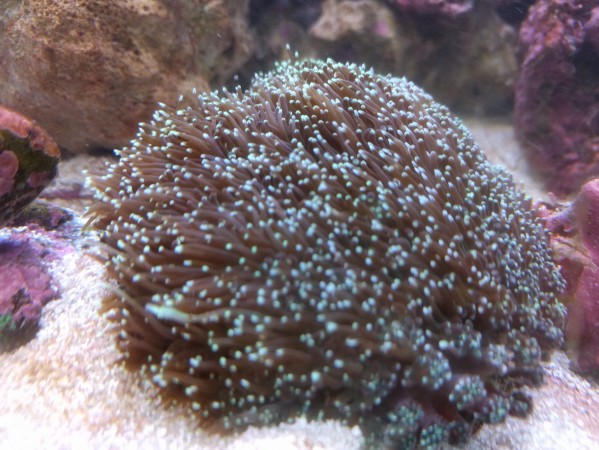
  • Pink Edge Hammer Euphyllia

    General information In general, corals from the genus Euphyllia have long tentacles that may stretch out 2 to 4 inches and are usually extended out most of the time. When the polyps are retracted, you can clearly see that each corallite is completely separated from each other and is encased by its own wall. This…

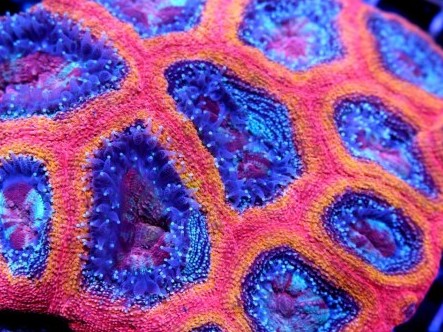
  • Rainbow Ring Acan

    General information This is the ideal range of water parameters for raising Rainbow Ring Acan in captivity: Calcium: 400 – 450 ppm Alkalinity: 3.2 – 4.8 MEQ/L Phosphates: 0 Magnesium: 1200 – 1350 Strontium: 8 – 10 Temperature: 76° – 83° F (24° – 28° C) Salinity / Specific Gravity: 1.023 – 1.025

  • Cortez Blue Favia

    General information In general, the genus Favia have large coral colonies that are circular in shape and comes in the form of massive, submassive and encrusting type. At a first glance, you can mistakenly identify Favia with Favites. However, with a closer look, Favia and Favites can easily be differentiated. Favites have corallite walls that…

  • Mind Blower Acan

    General information This is the ideal range of water parameters for raising Mind Blower Acan in captivity: Calcium: 400 – 450 ppm Alkalinity: 3.2 – 4.8 MEQ/L Phosphates: 0 Magnesium: 1200 – 1350 Strontium: 8 – 10 Temperature: 76° – 83° F (24° – 28° C) Salinity / Specific Gravity: 1.023 – 1.025

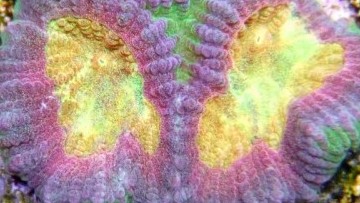
  • Variegated Sandalolitha

    General information In general, corals coming from the genus Sandalolitha  are big in size with a heavy colony. They are free living and their growth is not attached to the substrate. They have numemrous small corallites with polyps that are deeply embedded. As for the Variegated Sandalolitha, they are predominantly colored cream and dull green….

  • Orange Tongue Coral

    General information In general, corals coming from genus Herpolitha has an elongated skeletal structure with a single axis located at the center and a round-shaped edge. They are classfied as a monotypic type of mushroom coral where it only has one member – Herpolitha limax. Similar to Fungia corals, Herpolitha are solitary animals, which means that…