
Saltwater

  • Funky Acan

    General information This is the ideal range of water parameters for raising Funky Acan in captivity: Calcium: 400 – 450 ppm Alkalinity: 3.2 – 4.8 MEQ/L Phosphates: 0 Magnesium: 1200 – 1350 Strontium: 8 – 10 Temperature: 76° – 83° F (24° – 28° C) Salinity / Specific Gravity: 1.023 – 1.025

  • Dendrophyllia

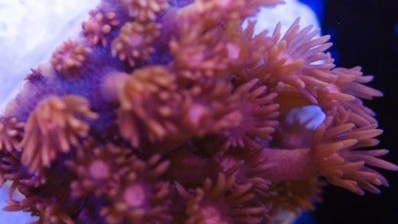
    General information In general, Dendrophyllia are classified as stony cup coral where their tentacles are enclosed in to a singe branch forming like a cup. Their polyps are usually small in size and extends out and exposed all the time regardless if it is night or day. Commonly called as the “Dendro” corals, they are…

  • Fiery Depths Acan

    General information Fiery Depths Acan has a well-pronounced columnae with polyps that are colored red-orange. Their mouth is deep with a color combination of yellow and orange. This is the ideal range of water parameters for raising Fiery Depths Acan in captivity: Calcium: 400 – 450 ppm Alkalinity: 3.2 – 4.8 MEQ/L Phosphates: 0 Magnesium:…

  • Green Torch Euphyllia

    General information In general, corals from the genus Euphyllia have long tentacles that may stretch out 2 to 4 inches and are usually extended out most of the time. When the polyps are retracted, you can clearly see that each corallite is completely separated from each other and is encased by its own wall. For…

  • Agent 420 Cyphastrea

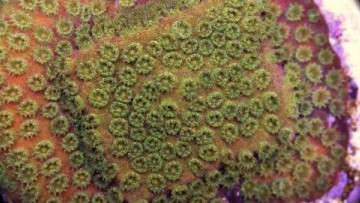
    General information n general, species from Cyphastrea are fast growing when you compare it to other mound-building corals. They usually grow in an encrusting form and can visually see a difference in size within 6 months. Newbies can cultivate Cyphastrea since they are easy to care and maintain. They can grow in a wide range…

  • Fruitopia Favia

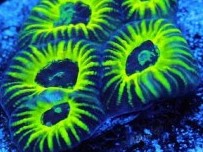
    General information In general, the genus Favia have large coral colonies that are circular in shape and comes in the form of massive, submassive and encrusting type. At a first glance, you can mistakenly identify Favia with Favites. However, with a closer look, Favia and Favites can easily be differentiated. Favites have corallite walls that…
  • Neon Green Leptoseris

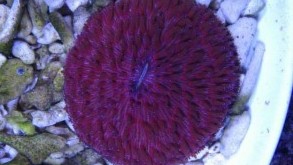
    General information In general, corals from the genus Leptoseris usually take the form of encrusting, foliose or plate type. Their colonies are laminar in nature which forms whorls, folds or tiers. Their corallites are arranged in an irregular pattern that usually runs parallel to the margins. For the Neon Green Leptoseris, they are predominatly colored…

  • Side Winder Favia

    General information In general, the genus Favia have large coral colonies that are circular in shape and comes in the form of massive, submassive and encrusting type. At a first glance, you can mistakenly identify Favia with Favites. However, with a closer look, Favia and Favites can easily be differentiated. Favites have corallite walls that…
  • Yellow Spectrum Favia

    General information In general, the genus Favia have large coral colonies that are circular in shape and comes in the form of massive, submassive and encrusting type. At a first glance, you can mistakenly identify Favia with Favites. However, with a closer look, Favia and Favites can easily be differentiated. Favites have corallite walls that…

  • Lucky Leprechaun Acan

    General information This is the ideal range of water parameters for raising Lucky Leprechaun Acan in captivity: Calcium: 400 – 450 ppm Alkalinity: 3.2 – 4.8 MEQ/L Phosphates: 0 Magnesium: 1200 – 1350 Strontium: 8 – 10 Temperature: 76° – 83° F (24° – 28° C) Salinity / Specific Gravity: 1.023 – 1.025