Scarlet Reef Hermit Crab
Paguristes cadenati
Featured guide
This will pull the most popular / featured article tagged to this species.
Water parameters
Water parameters are being added.
About Scarlet Reef Hermit Crab
General information
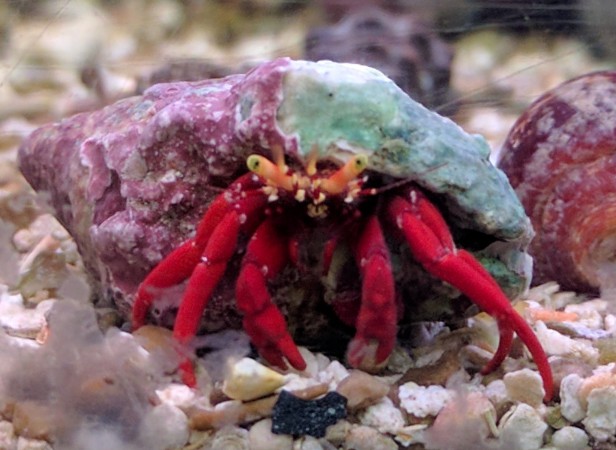
Paguristes cadenati is very hardy and requires minimal care in a well-established system. More importantly, however, these small hermit crabs have a voracious appetite for detritus and algae. In fact, they are particularly fond of nuisance algae of the filamentous, hair, and slime varieties, as well as cyanobacteria. Finally, unlike some hermit crabs, most Scarlet Reef Hermit Crabs are very peaceful towards their tankmates. The Scarlet Reef Hermit Crab is named for its bright red legs, which are contrasted by their yellow face. Native to the reef faces and coral rubble of the Caribbean and Western Atlantic, these active scavengers can consume large amounts of animal matter and algae. Despite their large appetites and constant feeding habits, the Scarlet Reef only grows to an adult size of 1-1/2″” in length. Like other hermit crabs, an ample supply of empty shells should be available for the Scarlet Reef Hermit Crab to move into as they molt and grow. As with all invertebrates, they do not tolerate copper-based medications and extreme fluctuations in water parameters. Also, take special care to ensure an invertebrate-friendly environment free of predators.
Diet & nutrition
The diet of Scarlet Reef Hermit Crab is mainly detritus and algae. It is also fond of filamentous, hairy, and slimy nuisance algae and cyanobacteria.
It is considered to be one of the reef safe hermit crabs that can be added in an aquarium. It is best kept in a reef system with adequate supply of algae since they eat almost anything. In areas with low algae supply, the scarlet reef hermit crab eats dried seaweed and other marine food.
Determining sex
Female scarlet reef hermit crabs can be distinguished from the males because of the presence of two tiny genital openings called gonopores. These are situated at the back of her legs, near the abdomen and the joint of the cephalothorax. Males do not have this characteristic.
Females have egg pouches; males do not.
Females also have little hair on their bodies compared to males.
Breeding & spawning
Sexual reproduction among female and male scarlet reef hermit crabs happens when they pull themselves out of their shells, and their midsections meet for a few minutes. Eggs are carried by the female crab until they are ready to be hatched. The young hermits will then be released while the lights are off.
However, breeding in the aquarium is extremely difficult.
Origination
Scarlet reef hermit crabs are native to the reef faces and coral rubble of the Caribbean and Western Atlantic.
Cautions
Almost every saltwater crab is sensitive to copper traces in the water so copper treatments should not be used in tanks with hermit crabs. They are also very sensitive to extreme fluctuations in water parameters.
Acclimation process
When taking the invertebrate out, expose it to as little light as possible and turn the aquarium lights off. Place the invertebrate container bag in the aquarium and let it float for 15 minutes. Open the bag and pour in 1 ounce of aquarium water into it, do so every 5 minutes until the water inside the bag has doubled. Wait for 5 minutes before pouring off half the water inside the bag into the aquarium. Then, slowly place each animal in the aquarium. Turn the aquarium lights on after an hour or more.
Related articles
These will pull posts tagged to this species (not tied to the species record).
All photos
Tap a photo to open the gallery viewer.