
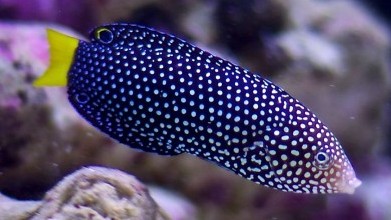
Yellowtail Wrasse
Anampses meleagrides
Saltwater Fish
Species Group: Wrasse
Family: Wrasse
Log in or create an account to add this species to your tanks.
Water parameters
Temp
76-80 F
Temperature
Maintaining a stable and appropriate temperature is critical for the survival of aquatic life.
pH 7.8 - 8.4 potential of HydrogenMeasuring the acidity or alkalinity of water on a 0–14 scale, where 7 is neutral, 7 is alkaline.
NO3 1-20 ppm NitrateWhile less toxic than ammonia, high nitrate levels (above 40–80 ppm) are important to monitor because they can cause fish stress, stunted growth, and harmful algae blooms.
NO2 <0.0001 ppm NitriteIt is a highly toxic, intermediate compound in the nitrogen cycle produced from broken-down ammonia
PO4 0.01 - 0.1 ppm PhosphateIt is essential for plant development but must be managed, as excess levels trigger nuisance algae blooms and inhibit coral calcification.
NH3 <0.1 ppm AmmoniaIt is the primary killer of aquarium fish, causing gill damage, stress, and death
Ca 380 - 450 ppm CalciumSupporting the growth, skeletal structure, and shell formation of corals, mollusks, crustaceans, and coralline algae
KH 8 - 12 dKH AlkalinityIt acts as a shield, neutralizing acids to prevent dangerous pH "crashes" that can harm fish, corals, and plants.
Mg 1200 - 1400 ppm MagnesiumIt enables coral growth by supporting skeletal formation, assists in metabolic processes, and ensures that calcium is available for corals, clams, and coralline algae.
SG 1.023 - 1.026 SG SalinityEssential for maintaining stable, natural water parameters, proper osmoregulation, and stress-free environments for marine fish and corals
ORP 250 - 400 mV Oxidation-Reduction PotentialA higher positive mV indicates clean, oxygen-rich water with high water quality, while low readings indicate high pollution.
About Yellowtail Wrasse
General information
This fish species is found widely distributed in tropical waters. Primarily it is found in the Pacific waters and those of the Indian ocean. It is not considered an endangered species as there have been no signs in the past to show that the species numbers have been on the decline. It is native to countries located on both the eastern and western side of the Indian ocean boundaries and the east, central, northwest and western side of the Pacific ocean boundaries.
It occupies a range of between 3 and 60 meters deep and is considered a demersal species due to its affinity for lower depths. It has a wide range of habitats as it may be found occuping both soft coral and hard coral areas. it can also be found inhabiting sea facing coral reefs, as well as areas where there is an accumulation of sand or limestone.
While it may be used as a delicacy in some cultures, it is a popular marine trade item in the Philipines and Indonesia. This particular wrasse species is capable of achieving a maximum length of 9 inches.
Diet & nutrition
The Yellowtail Wrasse is a carnivorous species known to feed on macro-invertebrates, such as pyramide snalis, sea urchins, flat worms, found on the ocean floors or at the bottom of sedimented habitats. Zooplanktons are also an important part of the wrasse's diet. When in captivity, its diet should consist of marine meat that is finely chopped, and live mysids and brine.
Determining sex
The yellowtail wrasse are known to be diandric species. However, this feature is only applicable to the females. Males are divided into two groups. Primary males are those that have been male all through their lives while secondary males are females that change dsex and became males. In a population that has few males, the females will easily change sex to fill the gap.
Breeding & spawning
The yellowtail is an oviparous species. They are known to either breed in pair or in a group of atleast one male and about six females. they have been observed, like other wrasse species, to spawn on reef outcrops, behaviour that is thought to encourage dispersal.
Diseases
There are no known diseases that threaten the Yellowtail wrasse.
Origination
It is originally found in tropical waters, particularly Indian Ocean and Pacific ocean waters. It is widely distributed in the Great reef, east, central and west pacific, east and west indian ocean, Indonesia, The Red Sea, and Australia.
Cautions
Wrasse are considered jumpers make sure your aquarium has a tight-fitting canopy or screen cover to prevent the Wrasse from jumping out of your aquarium. Wrasse have been known to jump through the smallest of holes in a canopy.
Wrasses prefer to have a 2" (5cm) sandbed to allow them to burrow into the sand to sleep or when they feel like they are in danger. Some people with bare bottom tanks have also added a Tupperware with a 2" deep sand bed to accommodate the wrasse's needs.
They are generally peaceful but may display aggression towards members of the same species.
Acclimation process
This particular species is rather difficult to maintain outside of its natural environment. It, however, requires an aquarium that is no less tha 60 gallons. There should also be an ample supply of rocks or corals in the aquarium meant to house it. These are important as they foster the growth of macro-invertebrates that the wrasse feed on. It also requires a minimum of 2 inches of sand. This acts as a hiding cover, whenever the fish feels threatenedfor one reason or the other, as well as resting cover.
If kept together with other species, then avoid placing them in the same aquarium with species smaller than them. While this is an altogether calm species, it is known to get aggressive when in contact with species smaller in size. Particularly, keep Sea Horses, Batfish, Psuedochromis, and Pipefish. You can pair it with Lionfish,Angelfish, Hawkfish ,Hogfish, and Frogfish. However, caution must be taken when doing so.
When first introduced into the aquarium, it will require a high feeding frequency until its natural foods can start growing within the aquarium. For higher survival chances, it is best to introduce it in its juvinile stage.
All photos
Tap a photo to open the gallery viewer.