Scribbled Angelfish
Chaetodontoplus duboulayi
Featured guide
This will pull the most popular / featured article tagged to this species.
Water parameters
Water parameters are being added.
About Scribbled Angelfish
General information
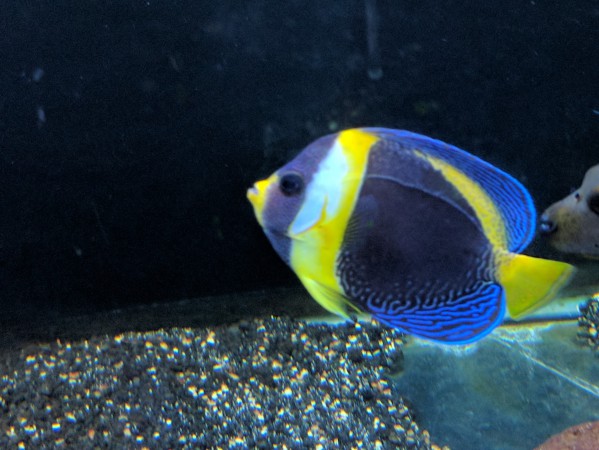
Scribbled Angelfish spawned and reared in land-based saltwater ponds in Bali Indonesia. The lips are a dull yellow while the face and body are predominately a dark blue-black. Separating the head from the body is a wide vertical band of yellow and white. A yellow stripe adorns the upper body and the caudal fin is also yellow. The Scribbled Angelfish derives its name from the many scrawls over the body and large dorsal and anal fins. Usually indistinguishable in color variations from male to female, the Scribbled Angelfish male may exhibit a small white patch on the gill cover. The Scribbled Angelfish requires a large area to swim, so it needs a large aquarium with many hiding places and live rock for grazing. Not a good candidate for a reef tank, the Scribbled Angelfish is prone to nip at stony and soft corals (sessile invertebrates) and clam mantles. It may be shy at first and should not be placed with aggressive tank mates. Once acclimated, however, it may become more aggressive.
Diet & nutrition
Scribbled angelfishes are omnivores that primarily feed on sponges and tunicates but may also consume macroalgae, coral polyps, and sea whips. In an aquarium setting, the scribbled angelfishes may be fed with a freshly opened clam or mussel, or live feeder mysis or brine shrimp to initiate a feeding response. Juvenile Scrbbled angelfishes may be fed with dried flakes, frozen prepared diets for sponge and algae eaters, frozen shrimps, and may also feed on tablets.
Determining sex
Scribbled angelfishes all start out as females and will change when the need arises. Males have a brighter blue body with a prominent and defined horizontal blue scrawling on the sides. Males also have longer bodies and have no interruptions of the yellow band that runs from the front, back, and down to the tail fin. The pattern on the female on the other hand are more of dots and dashes with black dots at the base of the tail fin.
Breeding & spawning
Courtship for this species usually occurs at dusk, this then progresses to an ascent to the water column by the males followed by females which eventually lead to the release of gametes in the water column for external fertilization. During courtship the male will trail behind the female positioning his snout to near the female's abdomen.
Diseases
Scribbled angelfishes are relatively hardy aquarium fishes, however they are also prone to diseases that captive saltwater environment has to offer. Disease include White Spot Disease caused by Cryptocaryon irritans which causes scratching and white dots on the fish which results in the fish suffocating from these parasites blocking the gills from providing oxygen. Another common disease is Marine Velvet caused by Oodinium ocellatum which results to a peppery coating giving a yellow to light brown "dust" on body, clamped fins, respiratory distress (breathing hard as seen as frequent or quick gill movements), cloudiness of eyes, glancing off decor or substrate, and possible weight loss.
Origination
Chaetodontoplus duboulayi are distributed in the Indo-West Pacific from Western Austraia, Queensland, the Northern Territory andsouthward to Lord Howe Island, southern New Guinea, and the Aru Islands in Indonesia.
Cautions
Scribbled angelfish can do well in a community tank and should be housed with other semi-aggressive fish. Peaceful and non-aggressive fish like cardinalfish, gobies, tilefish, damselfish, butterflyfish, fairy basslets, wrasses, etc. will be good tank mates. They will do well in a reef tank with soft corals like those from the Cladiella, Lemnalia, Lobophytum, and Sinularia genera. Mushroom corals and sea anemones will usually be left alone too.
Acclimation process
A minimum of 100 gallon tank is needed for adult Scribbled angelfish while 60 gallon aquarium will do for juveniles. The aquarium needs to be mature with plenty of algal growth on the live rocks. The fish also requires space for swimming for the adults and crevices for the juveniles to hide in when feeling threatened.
Related articles
These will pull posts tagged to this species (not tied to the species record).
All photos
Tap a photo to open the gallery viewer.