Rusty Angelfish
Centropyge Ferrugata
Featured guide
This will pull the most popular / featured article tagged to this species.
Water parameters
Water parameters are being added.
About Rusty Angelfish
General information
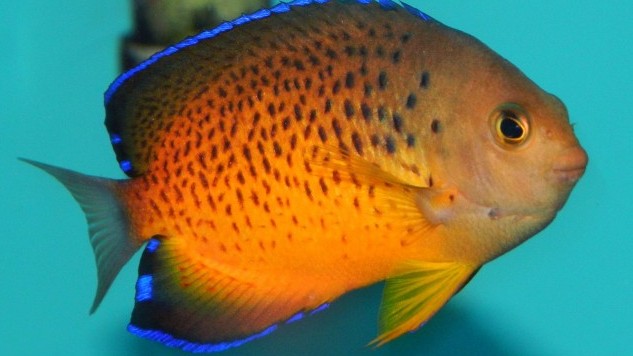
The Rusty Angelfish is aptly named for its predominate red or amber coloration punctuated with black dots that decrease in size from dorsal to anal and pelvic fins. The anal fin is dark and both the dorsal and anal fins are rimmed in bright, sapphire-blue.
Diet & nutrition
The Rusty Angelfish is an omnivore with natural diet consisting mostly of algae and detritus. They will also pick on the polyps of any stony coral and most soft corals, as well as tunicates, clam mantles, cnidarians, sea squirts and sponges.
In captivity, they readily feed on live and frozen foods with marine or Spirulina algae, mysid shrimp, shaved shrimp, and other high quality fare. In mature tanks, they are found grazing on live rocks with natural algae foods (containing copepods and other small edibles) and diatom algae. It has been also observed that they like to eat tubeworms and nibble on clams.
Determining sex
All Centropyge, including this species, are born as female, and as they grow within their social structure, the larger and more dominant fish will become male, while the remaining fish stay female. A bi-directional sex change has been confirmed for this species.
Breeding & spawning
This species can be bred in captivity. Rusty angelfishes requires a tall tank with proper lighting schedule which mimics the species natural environment is needed to encourage spawning in an aquarium setting. They are known broadcast spawners, relasing eggs and sperm simultaneously at dusk by rising into the water column and relasing the gametes at the top of the aquaria. Eggs will hatch within a day and should be fed with microscopic algae after 2 to 3 days from hatching.
Diseases
Rusty Angelfishes are susceptible to the common reef scourges such as parasites like White Spot Disease (Cryptocaryon irritans) or also known as Crypt, and Velvet Disease (Oodinium occelatum) which is a parasitic skin flagellate.
It is also vulnerable to bacterial and fungal diseases as a secondary infection from the parasitic and protozoan diseases. One major bacteria of concern is the Vibrio bacteria. It usually starts as an infection that turns into Dropsy, Popeye, Bleeding or Red Streaks on the skin. It is a very fast acting bacteria that can kill the fish within two days.
Origination
It is widely distributed in the western Pacific from Tanabe Bay in southern Japan, to the southwestern tip of Taiwan and the Philippines.
Cautions
These angelfish are generally not overly aggressive with their tankmates. Like most angelfish, they get along with tankmates best when they are the only type of dwarf angelfish in the aquarium. Only combine angelfishes with distinct color variations and when added with other dwarfs, they should be added at the same time. They may nip at stony coral polyps, sponges, clam mantles, tiny snails, and other invertebrates.
Acclimation process
This species can be kept in a mature tank over 30 gallons it they are the only fish, but do best with 55 gallons or more. The best environment is one with live rock that can help supply them with plenty of natural algal foods, and positioned to create lots of hiding places.
Related articles
These will pull posts tagged to this species (not tied to the species record).
All photos
Tap a photo to open the gallery viewer.