
Potter’s Angelfish
Centropyge potteri
Saltwater Fish
Species Group: Angel Dwarf
Family: Pomacanthidae
Log in or create an account to add this species to your tanks.
Water parameters
Temp
76-80 F
Temperature
Maintaining a stable and appropriate temperature is critical for the survival of aquatic life.
pH 7.8 - 8.4 potential of HydrogenMeasuring the acidity or alkalinity of water on a 0–14 scale, where 7 is neutral, 7 is alkaline.
NO3 1-20 ppm NitrateWhile less toxic than ammonia, high nitrate levels (above 40–80 ppm) are important to monitor because they can cause fish stress, stunted growth, and harmful algae blooms.
NO2 <0.0001 ppm NitriteIt is a highly toxic, intermediate compound in the nitrogen cycle produced from broken-down ammonia
PO4 0.01 - 0.1 ppm PhosphateIt is essential for plant development but must be managed, as excess levels trigger nuisance algae blooms and inhibit coral calcification.
NH3 <0.1 ppm AmmoniaIt is the primary killer of aquarium fish, causing gill damage, stress, and death
Ca 380 - 450 ppm CalciumSupporting the growth, skeletal structure, and shell formation of corals, mollusks, crustaceans, and coralline algae
KH 8 - 12 dKH AlkalinityIt acts as a shield, neutralizing acids to prevent dangerous pH "crashes" that can harm fish, corals, and plants.
Mg 1200 - 1400 ppm MagnesiumIt enables coral growth by supporting skeletal formation, assists in metabolic processes, and ensures that calcium is available for corals, clams, and coralline algae.
SG 1.023 - 1.026 SG SalinityEssential for maintaining stable, natural water parameters, proper osmoregulation, and stress-free environments for marine fish and corals
ORP 250 - 400 mV Oxidation-Reduction PotentialA higher positive mV indicates clean, oxygen-rich water with high water quality, while low readings indicate high pollution.
About Potter’s Angelfish
General information
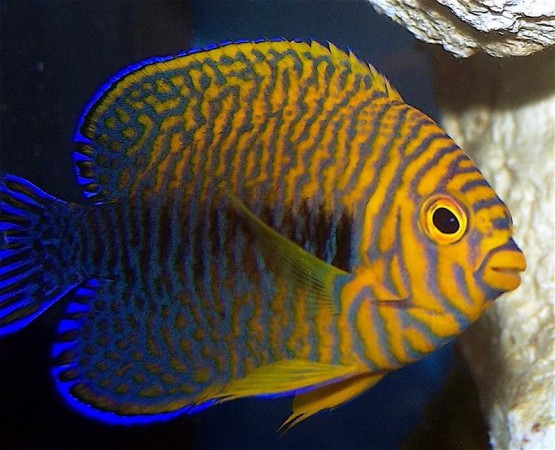
The Potter’s Angelfish, or Potter’s Pygmy Angelfish, is endemic to the Hawaiian Islands area, including the Johnston Atoll. The body is a brilliant orange, marbleized with pale to dark blue. The caudal portions of the dorsal and anal fins as well as the caudal fin are a dark blue-black.
Diet & nutrition
In the wild, the Potter's angelfish are omnivores found on rocky ledges feeding on algae and detritus. In captivity, it readily accepts a varied diet of live food, frozen food, meaty items, flake food, and algae. Ensure that the meaty items, such as mysis shrimp, are chopped up finely since this species have small mouths.
Determining sex
All Potter's angelfish are born female because of their protogynous hermaphroditism. In a small group of this species, usually the larger individual undergoes sex change to become male. Some observations on the typical orange variation have shown males to have more blue in the mid section, reaching usually to the bottom of the belly area.
Breeding & spawning
Potter's angelfish, Centropyge potteri, have been bred successfully in captivity at the Rising Tide and the Oceanic Institute at Hawaii Pacific University. Just like other dwarf angels, are broadcast spawning protogynous hermaphrodites.
Courtship begins at dusk when male soars above the female, hovers with his fins extended, and tilts at a 45-90 degree angle from the bottom. When the female is ready to spawn, it follows the male and initiates spawning with a mutual soaring display. The gametes are then released into the water column for external fertilization and usually hatches within a day.
Diseases
When subjected to stressed environments, Potter's angelfishes are susceptible to diseases such as White Spot Disease, Velvet Disease, and bacterial infections.
Parasites may cause scratching and flashing behavior of the affected fish which usually culminates to numerous white dots on the skin (White Spot Disease) or a peppery coating leaving a yellow to light brown "dust" on body (Velvet Disease). A secondary infection from these parasites may lead to bacterial infections which can kill the fish within days.
Origination
Potter's angelfishes are endemic in the Hawaiian Islands and Johnston Atoll.
Cautions
Potter's angelfish should not be kept with hyper active tankmates, since it tends to be reclusive and shy. Dwarf angelfishes of the same color, feeding habit, or size should also be avoided as it tends to become aggressive and territorial.
This species can be kept in reef tanks, however, it has been observed that it nips on large and small polyped soft corals, and clam mantles.
Acclimation process
For this fish to acclimatize in tank conditions, they need to be added in mature tanks with multiple hiding and grazing spaces such as living rocks.
All photos
Tap a photo to open the gallery viewer.