Potter’s Angelfish
Centropyge potteri
Featured guide
This will pull the most popular / featured article tagged to this species.
Water parameters
Water parameters are being added.
About Potter’s Angelfish
General information
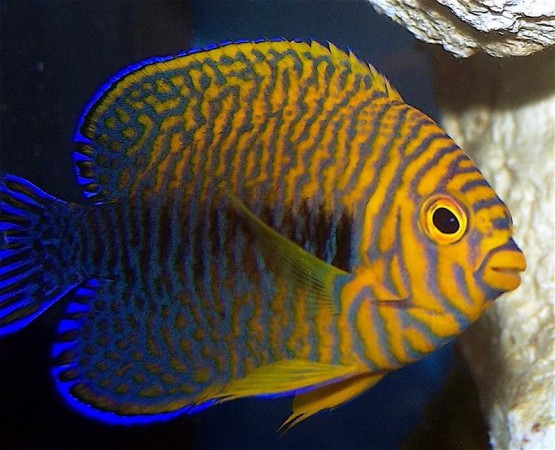
The Potter’s Angelfish, or Potter’s Pygmy Angelfish, is endemic to the Hawaiian Islands area, including the Johnston Atoll. The body is a brilliant orange, marbleized with pale to dark blue. The caudal portions of the dorsal and anal fins as well as the caudal fin are a dark blue-black.
Diet & nutrition
In the wild, the Potter's angelfish are omnivores found on rocky ledges feeding on algae and detritus. In captivity, it readily accepts a varied diet of live food, frozen food, meaty items, flake food, and algae. Ensure that the meaty items, such as mysis shrimp, are chopped up finely since this species have small mouths.
Determining sex
All Potter's angelfish are born female because of their protogynous hermaphroditism. In a small group of this species, usually the larger individual undergoes sex change to become male. Some observations on the typical orange variation have shown males to have more blue in the mid section, reaching usually to the bottom of the belly area.
Breeding & spawning
Potter's angelfish, Centropyge potteri, have been bred successfully in captivity at the Rising Tide and the Oceanic Institute at Hawaii Pacific University. Just like other dwarf angels, are broadcast spawning protogynous hermaphrodites.
Courtship begins at dusk when male soars above the female, hovers with his fins extended, and tilts at a 45-90 degree angle from the bottom. When the female is ready to spawn, it follows the male and initiates spawning with a mutual soaring display. The gametes are then released into the water column for external fertilization and usually hatches within a day.
Diseases
When subjected to stressed environments, Potter's angelfishes are susceptible to diseases such as White Spot Disease, Velvet Disease, and bacterial infections.
Parasites may cause scratching and flashing behavior of the affected fish which usually culminates to numerous white dots on the skin (White Spot Disease) or a peppery coating leaving a yellow to light brown "dust" on body (Velvet Disease). A secondary infection from these parasites may lead to bacterial infections which can kill the fish within days.
Origination
Potter's angelfishes are endemic in the Hawaiian Islands and Johnston Atoll.
Cautions
Potter's angelfish should not be kept with hyper active tankmates, since it tends to be reclusive and shy. Dwarf angelfishes of the same color, feeding habit, or size should also be avoided as it tends to become aggressive and territorial.
This species can be kept in reef tanks, however, it has been observed that it nips on large and small polyped soft corals, and clam mantles.
Acclimation process
For this fish to acclimatize in tank conditions, they need to be added in mature tanks with multiple hiding and grazing spaces such as living rocks.
Related articles
These will pull posts tagged to this species (not tied to the species record).
All photos
Tap a photo to open the gallery viewer.