
Multibar Angelfish
Paracentropyge multifasciata
Saltwater Fish
Species Group: Angel Dwarf
Family: Pomacanthidae
Log in or create an account to add this species to your tanks.
Water parameters
Temp
76-80 F
Temperature
Maintaining a stable and appropriate temperature is critical for the survival of aquatic life.
pH 7.8 - 8.4 potential of HydrogenMeasuring the acidity or alkalinity of water on a 0–14 scale, where 7 is neutral, 7 is alkaline.
NO3 1-20 ppm NitrateWhile less toxic than ammonia, high nitrate levels (above 40–80 ppm) are important to monitor because they can cause fish stress, stunted growth, and harmful algae blooms.
NO2 <0.0001 ppm NitriteIt is a highly toxic, intermediate compound in the nitrogen cycle produced from broken-down ammonia
PO4 0.01 - 0.1 ppm PhosphateIt is essential for plant development but must be managed, as excess levels trigger nuisance algae blooms and inhibit coral calcification.
NH3 <0.1 ppm AmmoniaIt is the primary killer of aquarium fish, causing gill damage, stress, and death
Ca 380 - 450 ppm CalciumSupporting the growth, skeletal structure, and shell formation of corals, mollusks, crustaceans, and coralline algae
KH 8 - 12 dKH AlkalinityIt acts as a shield, neutralizing acids to prevent dangerous pH "crashes" that can harm fish, corals, and plants.
Mg 1200 - 1400 ppm MagnesiumIt enables coral growth by supporting skeletal formation, assists in metabolic processes, and ensures that calcium is available for corals, clams, and coralline algae.
SG 1.023 - 1.026 SG SalinityEssential for maintaining stable, natural water parameters, proper osmoregulation, and stress-free environments for marine fish and corals
ORP 250 - 400 mV Oxidation-Reduction PotentialA higher positive mV indicates clean, oxygen-rich water with high water quality, while low readings indicate high pollution.
About Multibar Angelfish
General information
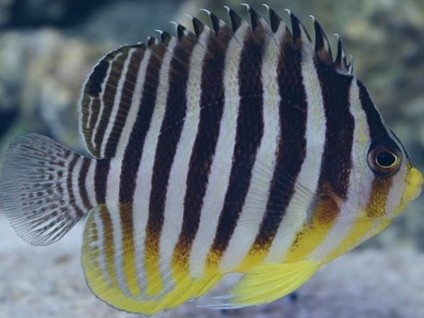
This species is a deeper-bodied species of dwarf angelfish with a white base color with eight black vertical bars that become yellowish ventrally and it grows to 12 cm SL. Juveniles possess fewer bars and have a distinctive ocellus on their dorsal fin that fades when they grow. It is usually found to inhabit caves and crevices in outer reef slopes and can be found in dpeths between 20 to 70 m.
Diet & nutrition
They are known to feed on algae, sponges, tunicates and other benthic invertebrates and small crustaceans and can often be seen foraging upside-down on cave ceilings. In captivity they may bed with diet of frozen and prepared food such as pelleted fish food or flakes, Artemia, Mysis, mussels and fresh oysters.
Determining sex
Paracentropyge multifasciata lives in harems with one dominant male and usually multiple females. Just like other angelfish, it is a protogynous hermaphrodite that start as females initially and the dominant and larger ones are changing to males.
Breeding & spawning
Barred angelfish are broadcast spawners, releasing their gametes into the water column after an intense and lengthy mating ritual that usually begins at dusk. However, it has been deemed difficult to breed in tank conditions.
Diseases
Angelfishes like the Multibar Angelfish are susceptible to common reef scourges such as parasites like White Spot Disease (Cryptocaryon irritans) or also known as Crypt, and Velvet Disease (Oodinium occelatum) which is a parasitic skin flagellate leaving white spots and golden flake lesions on the fish's skin. As a secondary infection from the parasitic and protozoan diseases. One major bacteria of concern is the Vibrio bacteria. It usually starts as an infection that turns into Dropsy, Popeye, Bleeding or Red Streaks on the skin. It is a very fast acting bacteria that can kill the fish within two days.
Origination
Paracentropyge multifasciatus have an extensive geographical distribution across much of the Pacific Ocean, and into the Indian Ocean peripheries. More specifically in the areas of Cocos-Keeling Atoll to the Society Islands, ranging north to the Yaeyama Islands and south to the Great Barrier Reef.
Cautions
Multibarred angelfish are known to nip on small crustaceans and worms. Provided with a large, mature aquarium with plenty of live rock and algae, this behavior might be avoided.
When first introduced in a tank, it may hide for the first day, though they may begin grazing on the rocks. As commonly seen with other dwarf angels, the Multibarred Angelfish is a territorial fish, and as such you will have to provide it with a lot of swimming space as well as plenty of crevices, holes and other hiding places.
Acclimation process
In sterile quarantine settings without live rock where not enough food can be found, as barred angelfish often do not accept artificial or frozen foods initially. Applying freshwater dips before placing P. multifasciata in their tanks is usually sufficient to prevent the introduction of protozoans via these fish.
Articles
All photos
Tap a photo to open the gallery viewer.