Keyhole Angelfish
Centropyge tibicen
Featured guide
This will pull the most popular / featured article tagged to this species.
Water parameters
Water parameters are being added.
About Keyhole Angelfish
General information
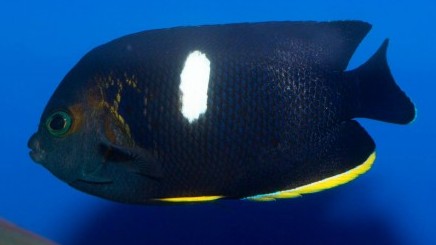
The Tibicen Angelfish is one of the largest of the Centropyge genus. Somewhat drab when compared to most other angelfish, the Tibicen Angelfish is primarily a dull blue to brownish-blue. The pelvic and lower portion of the anal fins are yellow. The egg-shaped, white vertical bar found in the mid-central body area gives it its name. It should have large amounts of live rock for hiding and grazing. It may nip at stony and soft corals (sessile invertebrates) and clam mantles. It will also feed on filamentous algae and diatoms.
Diet & nutrition
Keyhole angelfish are known to feed mainly on algae. However, they can be omnivores since they can take in diets consisting of Spirulina, marine algae, high-quality angelfish preparations, mysis or frozen shrimp, and other meaty items in tank conditions. Feeding should be done 2 to 3 times daily.
Determining sex
Color differentiation may be observed in Keyhole angels. Females are usually black overall while the males tend to be dark blue in color. In addition, since they are protogynous hermaphrodites, the larger individuals tend to undergo sex change to become a male to lead harems consisting of 3 to 7 individuals. Sexual reversal takes about 29 to 35 days to complete.
Breeding & spawning
Keyhole angels have been found difficult to breed in captivity. However, just like other dwarf angelfishes, they are known to be broadcast spawners releasing their gametes in the water column at dusk for external fertilization.
Reproductive behavior was observed during the courtship of a dominant male to a female Keyhole angelfish at dusk or before dimming the lights by soaring above her. He then hovers above her, extends his fins, and tilts at a 45-90 degree angle. The female then follows the male at the top of the aquarium. The male then rubs his nose into the side of the female. They then release eggs and sperms simultaneously at the top for external fertilization. Eggs will hatch within a day and should be fed with microscopic algae after 2 to 3 days from hatching.
Diseases
Common bacterial and parasitic diseases such as bacterial infection from Vibrio bacteria, the Crypt or White Spot Diseases and Velvet Diseasemay affect Keyhole angelfishes when tanks do not meet optimal conditions.
White spots and dusty golden film lesions may be observed on the fish's skin when affected by parasites. As a a secondary infection from the parasitic and protozoan diseases, they may be vulnerable to bacterial infections from Vibrio bacteria. It usually starts as an infection that turns into Dropsy, Popeye, Bleeding or Red Streaks on the skin. It is a very fast acting bacteria that can kill the fish within two days.
Origination
Keyhole angels are known to inhabit the Western Pacific Ocean and the Eastern Indian Ocean. They are distributed in Christmas Island to Fiji then northward to the southern part of Japan; southward to the Scott Reef, the Eastern Indian Ocean, and Lord Howe Island.
Cautions
Keyhole angelfishes are semi-aggressive and tends to bully fish that are similar in shape, size, or eating behavior when they are established in the tanks. It may also nip on stony and soft corals, sessile invertebrates, and clam mantles when housed in reef tanks, so caution must be applied when adding them to such environments.
Acclimation process
Provided with a tank with a minimum size of 70 gallons and with ample amounts of live rocks for hiding and grazing, Keyhole angels will thrive under tank conditions.
Related articles
These will pull posts tagged to this species (not tied to the species record).
All photos
Tap a photo to open the gallery viewer.