
Half Black Angelfish
Centropyge vroliki
Saltwater Fish
Species Group: Angel Dwarf
Family: Pomacanthidae
Log in or create an account to add this species to your tanks.
Water parameters
Temp
76-80 F
Temperature
Maintaining a stable and appropriate temperature is critical for the survival of aquatic life.
pH 7.8 - 8.4 potential of HydrogenMeasuring the acidity or alkalinity of water on a 0–14 scale, where 7 is neutral, 7 is alkaline.
NO3 1-20 ppm NitrateWhile less toxic than ammonia, high nitrate levels (above 40–80 ppm) are important to monitor because they can cause fish stress, stunted growth, and harmful algae blooms.
NO2 <0.0001 ppm NitriteIt is a highly toxic, intermediate compound in the nitrogen cycle produced from broken-down ammonia
PO4 0.01 - 0.1 ppm PhosphateIt is essential for plant development but must be managed, as excess levels trigger nuisance algae blooms and inhibit coral calcification.
NH3 <0.1 ppm AmmoniaIt is the primary killer of aquarium fish, causing gill damage, stress, and death
Ca 380 - 450 ppm CalciumSupporting the growth, skeletal structure, and shell formation of corals, mollusks, crustaceans, and coralline algae
KH 8 - 12 dKH AlkalinityIt acts as a shield, neutralizing acids to prevent dangerous pH "crashes" that can harm fish, corals, and plants.
Mg 1200 - 1400 ppm MagnesiumIt enables coral growth by supporting skeletal formation, assists in metabolic processes, and ensures that calcium is available for corals, clams, and coralline algae.
SG 1.023 - 1.026 SG SalinityEssential for maintaining stable, natural water parameters, proper osmoregulation, and stress-free environments for marine fish and corals
ORP 250 - 400 mV Oxidation-Reduction PotentialA higher positive mV indicates clean, oxygen-rich water with high water quality, while low readings indicate high pollution.
About Half Black Angelfish
General information
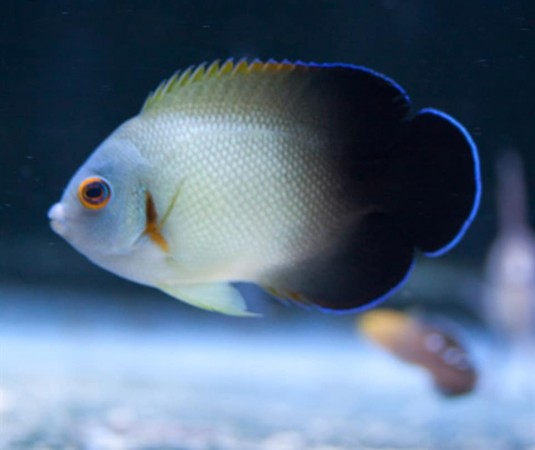
The Half Black Angelfish, like its name, it is half black and half pearled in coloration. The Half Black Angelfish should be the only dwarf angelfish in the tank. It is not a good reef dweller and may eat soft coral polyps, clam mantles, and zoanthids.
Diet & nutrition
Half Black angelfish are known to feed on a varied diet of algae and crustaceans in the wild. In captivity, its diet should include Spirulina, marine algae, mysis shrimp, and food preparation containing sponge and algae.
Determining sex
Just like other Centropyge species, Half Black Angelfish are unsexed at the start of their life and differentiate into female adults. The bigger sized individual within the group will change to become a male. Sex reversal is possible when the need arises.
Breeding & spawning
Half Black angelfish are well known to cross breeding with both the Eibli and Lemonpeel angelfish to create some interesting hybrid colorations. They are also observed to follow facultative and social monogamy, and distinctly pair with each other.
Diseases
Half Black angelfish may be easily affected by the common bacterial and parasitic diseases when optimal tank conditions are not met and mishandling occurs. Parasitic diseases such as White Spot Disease (Cryptocaryon irritans) or also known as Crypt, and Velvet Disease (Oodinium occelatum) which is a parasitic skin flagellate may cause lesions on the fish's skin. Bacterial infection from the Vibrio bacteria, as a result of parasites, may also lead into Dropsy, Popeye, Bleeding or Red Streaks on the skin and can kill the fish within two days.
Origination
Centropyge vroliki originates from the West Pacific region. Species distribution ranges from Christmas Island in the eastern Indian Ocean and Bali to the Marshall Islands and Vanuatu, north to southern Japan, south to Lord Howe Island and in the Tonga Reefs.
Cautions
Caution should be done when adding Half Black angels in reef tanks as they are known to nip on hard and soft coral polyps, clam mantles, and zoanthids.
Socially, Half Black Angelfish are generally peaceful fish but will often quarrel with members of their own species and even genus if they look similar enough. When housed with larger or more aggressive fish, they are often passive and peaceful. However, they may be bullied by such fish so careful observations must be done.
Acclimation process
Acclimation of Half Black angels usually takes 30 minutes or more provided that they are kept in tanks with plenty of hiding places and crevices such as live rocks.
All photos
Tap a photo to open the gallery viewer.