
Eibli Angelfish
Centropyge eibli
Saltwater Fish
Species Group: Angel Dwarf
Family: Pomacanthidae
Log in or create an account to add this species to your tanks.
Water parameters
Temp
76-80 F
Temperature
Maintaining a stable and appropriate temperature is critical for the survival of aquatic life.
pH 7.8 - 8.4 potential of HydrogenMeasuring the acidity or alkalinity of water on a 0–14 scale, where 7 is neutral, 7 is alkaline.
NO3 1-20 ppm NitrateWhile less toxic than ammonia, high nitrate levels (above 40–80 ppm) are important to monitor because they can cause fish stress, stunted growth, and harmful algae blooms.
NO2 <0.0001 ppm NitriteIt is a highly toxic, intermediate compound in the nitrogen cycle produced from broken-down ammonia
PO4 0.01 - 0.1 ppm PhosphateIt is essential for plant development but must be managed, as excess levels trigger nuisance algae blooms and inhibit coral calcification.
NH3 <0.1 ppm AmmoniaIt is the primary killer of aquarium fish, causing gill damage, stress, and death
Ca 380 - 450 ppm CalciumSupporting the growth, skeletal structure, and shell formation of corals, mollusks, crustaceans, and coralline algae
KH 8 - 12 dKH AlkalinityIt acts as a shield, neutralizing acids to prevent dangerous pH "crashes" that can harm fish, corals, and plants.
Mg 1200 - 1400 ppm MagnesiumIt enables coral growth by supporting skeletal formation, assists in metabolic processes, and ensures that calcium is available for corals, clams, and coralline algae.
SG 1.023 - 1.026 SG SalinityEssential for maintaining stable, natural water parameters, proper osmoregulation, and stress-free environments for marine fish and corals
ORP 250 - 400 mV Oxidation-Reduction PotentialA higher positive mV indicates clean, oxygen-rich water with high water quality, while low readings indicate high pollution.
About Eibli Angelfish
General information
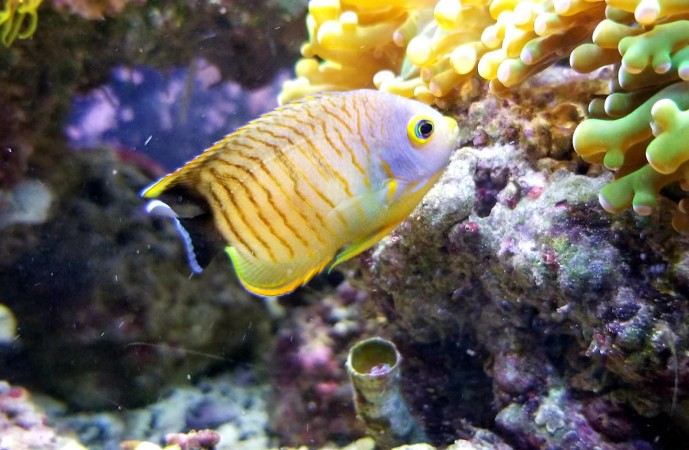
The Red Stripe Angelfish its pearlescent body is highlighted with several vertical, evenly-spaced orange to red stripes. The very back of the body and caudal fin are black. A brilliant sapphire-blue stripe outlines the caudal fin. Red Stripe Angelfish have tendencies to be docile, the Red Stripe Angelfish can become more assertive once established. It prefers not to be housed with other Dwarf Angels. It may occasionally nip at sessile invertebrates and clam mantles.
Diet & nutrition
The Eibli's Angelfish is an omnivore feeding on benthic algae, benthic seaweeds, and hard coral polyps in the wild. In the aquarium, varied diet should be given to these angels which should include Spirulina & marine algae as well as brineshrimp, Mysis shrimp, special sponge-based Angelfish preparations, and finely chopped krill, squid, cockle, or mussel.
Adult Eibli's angelfish should be fed twice a day or more and up to 4 times a day for a juvenile.
Determining sex
Centropyge eibli or Eibli's angelfish are protogynous fishes, which means they are sequential hermaphrodites or organisms that are born as female and at some point of their lifespan changes sex into a male. For this species, sex reversal occurs for 18 to 20 days.
As with other protogynous species, male are larger than their female counterparts. When the male dies, the dominant female will take over the role of the dominant male.
Breeding & spawning
In the wild this species form a small harem of one male and severala females, and may crossbreed with the Lemonpeel Angelfish, Centropyge flavissima, and the Pearlscale Angelfish, Centropyge vrolik also known as Halfback Angelfish to aquarists.
In captivity, breeding Eibli's Angelfish is a difficulty. A dominant male will court and spawn with the female in the aquarium having half the lights go out then, an hour later, the other half go out at a consistent time every day. From the bottom, the male will swim upwards and hover while tilting its body toward the female at a 45-90 degree angle.
When the female is ready to spawn, it follows the male and initiates spawning with a mutual soaring display. The gametes are then released into the water column for external fertilization.
Diseases
Angelfishes such as the Eibli's Angelfish might be able to contract common bacterial diseases such as Cotton wool disease, Vibrio bacterial disease, and Fish tubercolosis. Cotton wool disease is exhibited as an expanding translucent layer that eats away on the skin. Vibrio Bacterial disease on the other hand are exhibited by Dropsy, Popeye, Bleeding or Red Streaks on the skin. Lastly, Fish T.B. usually shows up as a loss of color and swelling of the body. It can also display blood streaks and blood spots anywhere in the body.
Aside from bacterial diseases, angelfishes my be affected by common reef scourges such as the Crypt or White Spot Diseases and Velvet Disease. Tiny white spots on the skin of the fish is one of the tell-tale sign of infection of the Crypt while dusty golden film on the skin or the eyes of the angelfish will detect the presence of Velvet Disease.
Origination
Centropyge eibli are highly distributed in the Eastern Indian Ocean, ranging from Sri Lanka to Western Australia including Indonesia and the Andaman Island. It can also be found in the Maldives, Thailand, Malaysia, Christmas and Cocos-Keeling Islands and the Southern Great Barrier Reef.
Cautions
Eibli's angelfish are shy, retiring and darting into holes and crevices when first introduced in the tanks. It shouldn't be kept with other competing algae fish in a small 55 gallon tank but will adapt best in larger tanks. It is best to introduce the Eibli's Angelfish as the last inhabitants while young into an established tanks, unless more agressive fish will be added afterward.
This dwarf angel are best kept in fish only aquarium and may possibly be kept in a reef setting, but it can damage coral species. A larger tank, about 75-100 gallons, will provide plenty of of places to hide and avoid territorial and agressive behavior. Introduction of more aggressive species should be done after it has acclimated and is confirmed to be eating well.
Acclimation process
The tank should be well decorated with rocks/ corals with many hiding places even for adults. When first introduced in the tanks, Eibli's Angelfish are quite shy but once it successfully acclimated it will become a hardy fish.
All photos
Tap a photo to open the gallery viewer.