Bluefin Angelfish
Centropyge multispinis
Featured guide
This will pull the most popular / featured article tagged to this species.
Water parameters
Water parameters are being added.
About Bluefin Angelfish
General information
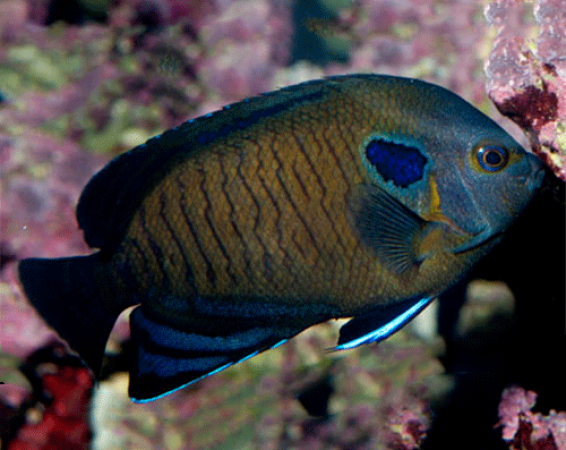
The Bluefin Angelfish is a blackish-blue dusky color, with lighter blue marbling on the dorsal, caudal, and anal fins; and a thin, sapphire-blue outline on the anal and caudal fins. Lots of hiding places and live rock for grazing will provide a good environment. The smaller the environment, the more aggressive the Bluefin Angelfish will be. Not a good reef dweller, the Bluefin Angelfish is prone to nip at sessile invertebrates.
Diet & nutrition
Bluefin Angelfishes are omnivores, living normally on microalgae and detritus. For tank conditions, it requires a diet rich in both meaty and green food such as mysis and brine shrimp, spirulina and high quality pellet and flake foods (e.g. Nori).
Determining sex
It is a protegynous hermaphrodite. It can change sex from female to male when the need arises; should a dominant male lose the status of being the dominant male they are capable of changing back into a female. It is presumed that the larger and attractively colored specimen are males.
Breeding & spawning
It is difficult to breed this species in captivity. In the wild it form loose harems consisting of 1 dominant male and several females. Spawning typically occurs at dusk when the male will swim upwards and hover above the female while tilting its body toward the female at a 45-90 degree angle. Once ready to spawn, the female will follow the male and soar together. Gametes will then be released to the water column for external fertilization. Once done, the pair will break apart for the male to find the next receptive female.
Diseases
Bluefin Angelfishes are susceptible to the common parasites such as Crypt or White Spot Diseases (Cryptocaryon irritans) and Velvet disease (Oodinium occelatum). Tiny white spots on the skin of the fish is one of the tell-tale sign of infection of the Crypt while dusty golden film on the skin or the eyes of the angelfish will detect the presence of Velvet Disease. It is also vulnerable to bacterial and fungal diseases as a secondary infection from the parasitic and protozoan diseases such as the Vibrio bacteria. Exposure to this bacteria can lead to an infection that turns into Dropsy, Popeye, Bleeding or Red Streaks on the skin. It is a fact acting bacteria that can kill the fish within 2 days.
Origination
Centropyge multispinis are widely distributed in the Indo-West Pacific region. Ranging from East Indian Ocean (Africa), West Indian Ocean, Australia, The Red Sea, Indonesia, and Central/West Pacific (Thailand).
Cautions
It is suitable for reef aquarium but with caution since it is known to pick on hard and soft corals as well as some inverts like clams. The Dusky Angelfish should be kept singly and not with any other members of the Centropyge genus as it can become territorial in addition of new species. In keeping angelfishes together, it should be provided with ample space to avoid fighting over territories. It is recommended that this species should be the last addition to the aquarium.
Acclimation process
It can be quite shy when first introduced in the aquarium and may take a little time to settle to become fully accustomed to the aquarium environment. Good water movement is much appreciated, and plenty of live rock is essential for shelter/grazing. When adding similar sized angelfish, it would be best if they are added simultaneously and that the least aggressive should be introduced first followed by the most docile.
Related articles
These will pull posts tagged to this species (not tied to the species record).
All photos
Tap a photo to open the gallery viewer.