Black Velvet Angelfish
Chaetodontoplus melanosoma
Featured guide
This will pull the most popular / featured article tagged to this species.
Water parameters
Water parameters are being added.
About Black Velvet Angelfish
General information
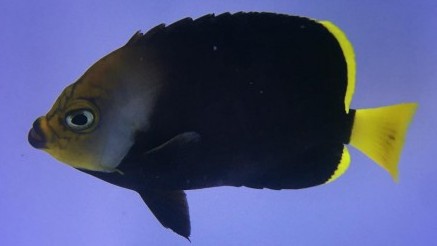
The beautiful and hardy Blue-velvet angelfish basically has an overall black to dark brown body, a yellowish-brownish face with yellowish orange spots on the forehead, and its dorsal and anal fins are edged in yellow. This angelfish grows up to 20 cm in length. It is usually found to inhabit coastal and outer rocky or coral reefs in the wild, often exposed to strong currents and cool upwelling.
This is one of the easier angelfish to keep especially if a smaller specimen is acquired, since they’re not generally fussy with food preferences. Juveniles of this species are particularly striking being black with bright yellow accents, particularly the broad yellow border at the edge of of the upper fin straight down through its tail and the back of anal fin.
Diet & nutrition
Black velvet angels are primarily omnivores, but mainly feeds on sponges and tunicates in the wild with the occasional weeds and algae. In the tank, new individuals tend to be picky. It is best to let them feed on sponge encrusted or algae covered rocks, or even live brine shrimp to encourage initial feeding response.
If the fish is able to acclimatize, they can now be fed with prepared and frozen food that are finely chopped such as seafood, flake food, and food with sponge material.
Determining sex
Black-velvet angelfish Chaetodontoplus melanosoma are protogynous hermaphrodites, that they are born as females but changes into males when the need arises. No sexual dimorphism is observed with this species, however, the largest Black-velvet angelfish individual in a tank or group tends to turn into a male.
Breeding & spawning
The Black-velvet angelfish has not yet been bred in captvity. This species is usually foun solitary or in pairs. Spawning for this angelfish has been observed to be similar with Vermiculated Angelfish Chaetodontoplus mesoleucus. Courtship starts at dusk when the male swims above the female, with its fins extended and body tilted. When ready, the female swims to the area that the male has designated as their spawning site. They will both soar up the water column, as the male nuzzles the female belly. Gametes will be released in the water column for external fertilization to happen. The larvae will be left with no parental care.
Diseases
Black Velvet Angelfish is quite hardy, however, they are prone to any disease that captive saltwater environments have to offer. Most likely this species might contract White Spot Disease Cryptocaryon irritans, Marine Velvet or Velvet Disease Oodinium ocellatum, Lymphocystis which is a viral infection, and parasitic flukes.
Origination
This species are strictly found in the regions of central Indonesia (western Java, Bali, Komodo, Flores, Sulawesi, and northeastern Kalimantan), Malaysia (Sabah), and the Philippines (Sulu Archipelago, Cebu, and southern Luzon).
Cautions
Best kept in tanks with smaller and non-aggressive fishes since it is also considered as one of the less aggressive angelfishes. Juveniles shouldn't be housed together since they will fight. Two adult Black Velvet Angelfish may be kept in the same tank, provided that it is large and they don't compete for space.
This species should be well fed since they will nip at hard corals, tubeworms, and clams if not.
Acclimation process
New individuals should be allowed to feed on sponge encrusted or algae covered rocks, or even live brine shrimp to encourage initial feeding response before feeding prepared meals.
A minimum tank size of 75 gallon is required for this species, with plenty of established and mature live rock for grazing and hiding place.
Related articles
These will pull posts tagged to this species (not tied to the species record).
All photos
Tap a photo to open the gallery viewer.