
Asfur Angelfish
Pomacanthus asfur
Saltwater Fish
Species Group: Angel Large
Family: Pomacanthidae
Log in or create an account to add this species to your tanks.
Water parameters
Temp
76-80 F
Temperature
Maintaining a stable and appropriate temperature is critical for the survival of aquatic life.
pH 7.8 - 8.4 potential of HydrogenMeasuring the acidity or alkalinity of water on a 0–14 scale, where 7 is neutral, 7 is alkaline.
NO3 1-20 ppm NitrateWhile less toxic than ammonia, high nitrate levels (above 40–80 ppm) are important to monitor because they can cause fish stress, stunted growth, and harmful algae blooms.
NO2 <0.0001 ppm NitriteIt is a highly toxic, intermediate compound in the nitrogen cycle produced from broken-down ammonia
PO4 0.01 - 0.1 ppm PhosphateIt is essential for plant development but must be managed, as excess levels trigger nuisance algae blooms and inhibit coral calcification.
NH3 <0.1 ppm AmmoniaIt is the primary killer of aquarium fish, causing gill damage, stress, and death
Ca 380 - 450 ppm CalciumSupporting the growth, skeletal structure, and shell formation of corals, mollusks, crustaceans, and coralline algae
KH 8 - 12 dKH AlkalinityIt acts as a shield, neutralizing acids to prevent dangerous pH "crashes" that can harm fish, corals, and plants.
Mg 1200 - 1400 ppm MagnesiumIt enables coral growth by supporting skeletal formation, assists in metabolic processes, and ensures that calcium is available for corals, clams, and coralline algae.
SG 1.023 - 1.026 SG SalinityEssential for maintaining stable, natural water parameters, proper osmoregulation, and stress-free environments for marine fish and corals
ORP 250 - 400 mV Oxidation-Reduction PotentialA higher positive mV indicates clean, oxygen-rich water with high water quality, while low readings indicate high pollution.
About Asfur Angelfish
General information
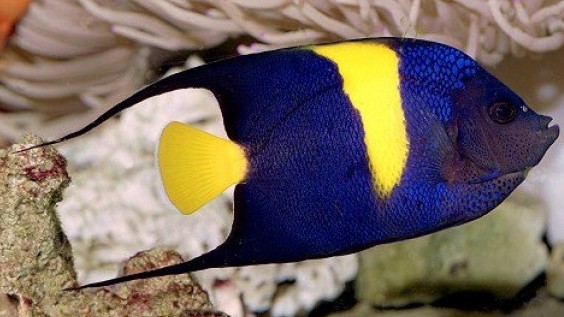
The Asfur Angelfish originating in the Red Sea, but also found in the Indo-Pacific, the Asfur has a dark blue/purple body, black face, yellow tail, and a predominant yellow crescent bisecting the body vertically. Often confused with Pomacanthus maculosus, the Asfur Angelfish has a bright yellow tail. As with some other Pomacanthus, the coloration of the juvenile differs markedly from the adult. A shy fish that does best when not kept with other Asfurs due to territorial behavior, the Asfur Angel requires a large tank with numerous hiding places and live rock for grazing. The Asfur Angelfish is prone to nip at stony and soft corals (sessile invertebrates) and clam mantles, but may be kept with small polyped stony corals and somewhat noxious soft corals.
Diet & nutrition
Asfur Angelfish Pomacanthus asfur feeds mostly on tunicates and sponges. These large angelfish are omnivores, they can eat a varied diet consisting of sponges with small amounts of algae, tunicates, hydroids, and bryozoans.
Determining sex
Asfur angelfishes are protogynous hermaphrodites, there is no physical evidence for sexual differences. However, fishes that are bigger tend to change to become males when the need arises.
Breeding & spawning
Difficult but possible to breed in captivity. Spawning usually commence at dusk when this species release their eggs and sperm simultaneously by rising into the water column and relasing the gametes at the top of the aquaria. They can hybridize with the Red Sea Angelfish or Yellowbar Angelfish, Pomacanthus maculosus.
Diseases
Asfur angelfish, like other angelfish, are prone to saltwater environment diseases if water and environmental conditions are not kept at the optimum. This angelfish may suffer from Saltwater Ich or White Spot Disease which is caused by Cryptocaryon irritans. This is exhibited as a constant scratching by the fish which culminates to white dots on its skin. Another common disease experienced by saltwater angelfishes is Velvet Disease caused by Oodinium ocellatum which is a parasitic skin flagellate. Symptoms include a peppery coating giving a yellow to light brown dust on the body.
Asfur Angelfish need decent reef-like lighting or they can develop Head and Lateral Line Erosion Disease (HLLE) - Hole-in-the-Head Disease. If untreated, this disease usually starts as small pits in the head and face that turns into large cavities progressing along a lateral line.
Origination
This species is widely distributed in the Western Indian Ocean, Red Sea, and Gulf of Aden, then south to Zanzibar in Tanzania.
Cautions
This species were observed to nibble on large polyp stony corals and clam mantles when not fed properly, they may also be a threat to decorative shrimps. They are notably shy and not easy to approach, and tend to need more hiding places like rocks and crevices to feel secure.
Like other angelfish, they are quite territorial hence, they should be provided with enough swimming space to avoid becoming aggressive.
Acclimation process
Asfur angelfish's are sensitive to water quality, hence, it should be kept at a pristine condition. This species aclimatize best when introduced into the tanks as a juvenile.
All photos
Tap a photo to open the gallery viewer.