Annularis Angelfish
Pomacanthus annularis
Featured guide
This will pull the most popular / featured article tagged to this species.
Water parameters
Water parameters are being added.
About Annularis Angelfish
General information
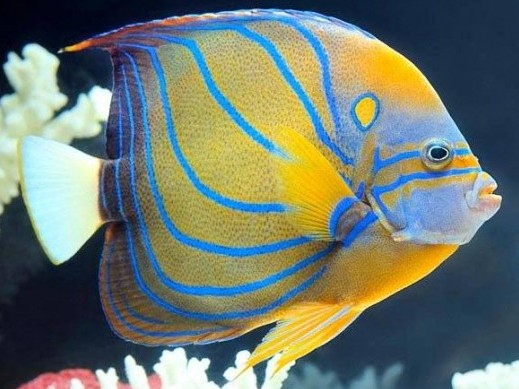
Annularis Angelfish spawned and reared in land-based saltwater ponds in Bali Indonesia. As a juvenile, the stripes run vertically and are white to light blue developing into the brilliant sapphire stripping seen in adults. The black body of the juvenile will also begin to soften into the brownish coloration sported by adults. As an adult, they have brilliant sapphire stripes running diagonally from their chest up to their soft posterior dorsal fin over a predominantly brown body and whitish-blue tail. Although these fishes can reside in smaller sized aquariums initially, a large tank is necessary for a single Annularis adult as they grow quite large for an Angelfish. Provide plenty of hiding places such as caves and live rock for grazing. Like most other larger angelfish, they will nip at sessile invertebrates such as tube worms, feather dusters, clams, along with soft and stony corals. All Angelfish are considered hermaphroditic, and visibly, it is not possible to differentiate males from females with the exception of their body shape when they are fully mature. Additionally, these fishes are semi-aggressive and they can become territorial once acclimated to the aquarium.
Diet & nutrition
The Ble-ringed angelfish Pomacanthus annularis are omnivores feeding on benthic invertebrates such as zooplankton, sponges, tunicates and coral polyps. Also these fish eat ascidians, algae, weeds, and nektonic fishes. In the aquarium this fish will readily feed on prepared mixtures containing sponge materials, frozen meaty products such as shrimps and diet containing algae such as Nori flakes.
Adults should be fed at least twice a day while juveniles should be fed 3 to 4 times a day.
Determining sex
This species are considered as protogynous hermaphrodites, meaning it begins its life as females. They then develop to larger fishes which usually turns to male, when the reproductive needs arises.
Breeding & spawning
Annularis angelfish can be bred in tanks, however rearing the larvae has been difficult. In the wild, Pomacanthus annularis spawn at the onset of dusk. Adults engage in a courtship display where the male and female swim in a brisk head to tail circling motion. Each pair will spawn and ascend into the water column. Spawning is done per harem or small group.
Diseases
Annularis angelfish, like other angelfish, are prone to saltwater environment diseases if conditions are not kept at the optimum. This angelfish may suffer from Saltwater Ich or White Spot Disease which is caused by Cryptocaryon irritans. This is exhibited as a constant scratching by the fish which culminates to white dots on its skin. Another common disease experienced by saltwater angelfishes is Velvet Disease caused by Oodinium ocellatum which is a parasitic skin flagellate. Symptoms include a peppery coating giving a yellow to light brown dust on the body.
Origination
This species is widely distributed in the Indo-Pacific region ranging from Sri Lanka to the Solomon Islands and from the Philippines to the northern tip of Australia.
Cautions
Annularis angelfish are best kept in a fish only aquarium since they may nip on polyps of both hard and soft corals as well as invertebrates like live shrimps. It is a semi-aggressive tank mate and can become aggressive towards more passive tank mates such as butterflyfish, batfish, and trunkfish.
Acclimation process
When adding into tans as juveniles, it is best to provide them with enough hiding spaces. Adults, with optimum size for adapting in tanks are 4-6” (10-14 cm) in length, on the other hand are usually found outside of caves or hiding places.
Related articles
These will pull posts tagged to this species (not tied to the species record).
All photos
Tap a photo to open the gallery viewer.