UFO Scoly
Scolymia australis
Featured guide
This will pull the most popular / featured article tagged to this species.
Water parameters
Water parameters are being added.
About UFO Scoly
General information
In general, corals coming from the genus Scolymia are round solitary corals that has a single mouth located at the center. Their coloration usually has an alternating radial bands with a cup, saucer, flat or dome shaped variations.
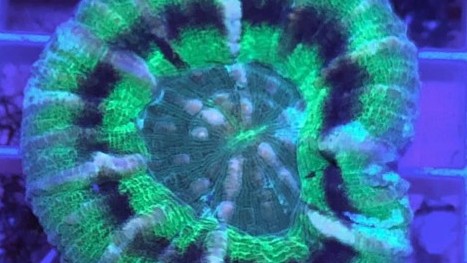
As for the UFO Scoly, they are predominantly colored green and violet arranged in a circular pattern. This are the water parameters for cultivating UFO Scoly:
- Calcium: 400 – 450 ppm
- Alkalinity: 2.86 – 4.29 MEQ/L (8 – 12 dKH)
- Phosphates: 0
- Magnesium: 1200 – 1350
- Strontium: 8 -10
- Temperature: 72° – 78° F (22° – 26° C)
- Salinity / Specific Gravity: 1.023 – 1.025
- pH: 8.1 – 8.4
Diet & nutrition
The primary nourishment of the UFO Scoly is provided by the symbiotic zooxanthllae living within its tissues. But on top of this, we recommend you still do supplemental feeding by adding mysis or brine shrimp.
Determining sex
A mature tank is highly recommended in propagating UFO Scoly. They need to be set at the bottom level of the tank.
Breeding & spawning
The UFO Scoly requires moderate lighting and low water flow.
Origination
The UFO Scoly can be found in the waters of the Indo-Pacific Ocean, particularly in Japan, Malaysia, Polynesia and Australia.
Cautions
You have nothing to worry about UFO Scoly. They have a peaceful behaviour and do not attack even if there is a nearby coral.
Acclimation process
UFO Scoly are a marine species. Therefore, salinity must be entirely maintained at 1.023 to 1.025 specific gravity.
Related articles
These will pull posts tagged to this species (not tied to the species record).
All photos
Tap a photo to open the gallery viewer.