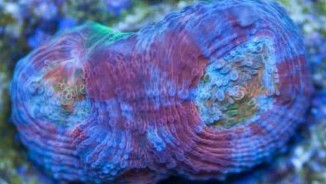
Sunset Watermelon Echinata
Acanthastrea echinata
Featured guide
This will pull the most popular / featured article tagged to this species.
Water parameters
Water parameters are being added.
About Sunset Watermelon Echinata
General information
In the wild, Sunset Watermelon Echinata comes in two forms: either encrusting or massive. Their colonies may reach over a meter in length. They have circular corallites with thick walls and septa that have long and pointed teeth. Their skeleton is covered with a dense, fleshy tissue that usually forms a concentric fold.
For the Sunset Watermelon Echinata, they are predominatly colored violet red with orange mouth. This are the water parameters for cultivating Sunset Watermelon Echinata:
- Calcium: 400 – 450 ppm
- Alkalinity: 3.2 – 4.8 MEQ/L
- Phosphates: 0
- Magnesium: 1200 – 1350
- Strontium: 8 – 10
- Temperature: 76° – 83° F (24° – 28° C)
- Salinity / Specific Gravity: 1.023 – 1.025
Diet & nutrition
In the wild, Sunset Watermelon Echinata has developed a symbiotic feeding relationship with marine algae called zooxanthellae. But in captivity, you have to feed them with nanoplankton or dissolved organics.
Determining sex
A mature tank is highly recommended in propagating Sunset Watermelon Echinata. Thriving them with fish is recommended as fish excretes nitrogen that can sustain the coral's growth.
Breeding & spawning
Sunset Watermelon Echinata does not need a high flow rate and intense light. Giving them moderate lighting allows the Acan Echinata to spread their polyps thereby allowing them to feed. Too much light will cause the polyps to be retracted.
Origination
Sunset Watermelon Echinata can be found throughout the Indo-Pacific region. They are widely distributed from East Africa (the Red Sea to Polynesia), Japan, Marshall Islands, and the Great Barrier Reef and Solitary Islands of Australia.
Cautions
Except for their own kind, Sunset Watermelon Echinata is aggressive towards other species. During the night, they extend their tentacles and sting nearby corals. It is recommended to observe proper spacing between corals. Further, they have the tendency to be overpowered with soft corals and will die especially if soft corals outnumber them.
Acclimation process
Sunset Watermelon Echinata is purely marine. So, therefore, salinity must be maintained thoroughly at 1.023 to 1.025 specific gravity.
Related articles
These will pull posts tagged to this species (not tied to the species record).
All photos
Tap a photo to open the gallery viewer.