- Name:
Halloween Hermit Crab
- Family: Diogenidae
- Species: Crab
- Scientific Name: Ciliopagurus strigatus
-
Difficult
Care Level
-
Aggressive
Temperament
-
Omnivore
Diet
-
0%
Reef Safe
- 77.2
Temp (Temperature)
- 7.89
pH (pH)
- NAN
NH3-4 (Ammonia)
- 20
NO3 (Nitrate)
- 0.1
PO4 (Phosphate)
- 6
AT (Alkalinity)
- 420
Ca (Calcium)
- 1350
Mg (Magnesium)
- 1.025
SG (Salinity)
- NAN
ORP (Oxidation Reduction Potential)
- 0
Avg. Size (Inches)
- 70
Avg.Tank Size (Gallons)
- 5
Avg Life (Years)
General info about Halloween Hermit Crab
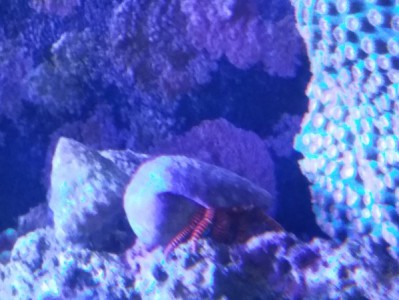
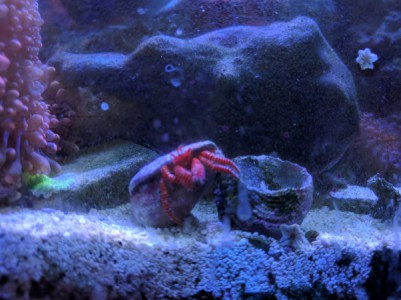
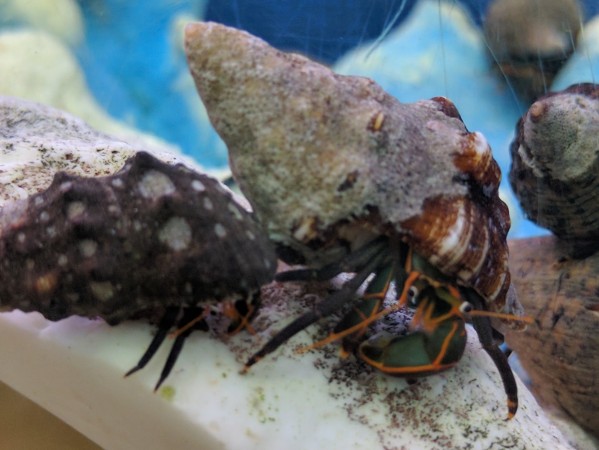
The Halloween Hermit Crab, with its vibrant orange and red banding, stands out as a member of your aquarium cleanup crew. Originating from the Hawaiian Islands, the Halloween Hermit Crab boasts attractive color variegation and is a beautiful accent to the aquarium. It is considered to be the most brightly-colored hermit crab. It can grow up to 2 inches (5.1 cm) long. It is nocturnal, and it lives in cone shells. It can live up to 10 years.
Halloween Hermit Crab Diet & Nutrition
It is omnivorous, and it is also a scavenger that can eat anything within its environment. It mainly subsists on animal material and filamentous algae and detritus. It efficiently feeds on green hair algae and cyanobacteria. When algae is scarce, it will feed on dried seaweed and mysis shrimp.
Determining Sex of Halloween Hermit Crab
Male crabs have a triangular-shaped apron on its ventral side while broad apron can be found in females.
Halloween Hermit Crab Origin
It originated from the Hawaiian region and is native to the Indo-Pacific region, including the Red Sea.
Caution with Halloween Hermit Crab
It can become aggressive towards other invertebrates in the aquarium, but such can be prevented when it is well fed with meats.
Acclimating Halloween Hermit Crab
When taking the invertebrate out, expose it to as little light as possible and turn the aquarium lights off. Place the invertebrate container bag in the aquarium and let it float for 15 minutes. Open the bag and pour in 1 ounce of aquarium water into it, do so every 5 minutes until the water inside the bag has doubled. Wait for 5 minutes before pouring off half the water inside the bag into the aquarium. Then, slowly place each animal in the aquarium. Turn the aquarium lights on after an hour or more.
Original Detail
| Name | Species | Family | Scientific Name | More Detail | Added by |
|---|---|---|---|---|---|
| Halloween Hermit Crab | Crab | Diogenidae | Ciliopagurus strigatus | The Halloween Hermit Crab, with its vibrant orange and red banding, stands out as a member of your aquarium cleanup crew. Originating from the Hawaiian Islands, the Halloween Hermit Crab boasts attractive color variegation and is a beautiful accent to the aquarium. It is considered to be the most brightly-colored hermit crab. It can grow up to 2 inches (5.1 cm) long. It is nocturnal, and it lives in cone shells. It can live up to 10 years. |
PalaciosAn |
Changed by users
| Submitted Date | Submitted By | Status | Action |
|---|