Peppered Cory Cat
Corydoras paleatus
Featured guide
This will pull the most popular / featured article tagged to this species.
Water parameters
Water parameters are being added.
About Peppered Cory Cat
General information
Pepper Corys have been kept as pets for over 100 years and are one of the first species to have been bred in captivity. Besides the standard variety, there is also a long-finned variety and an albino variety.
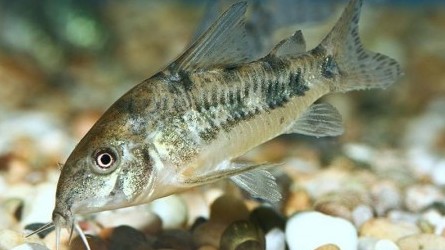
They are bronze and have dark green markings covering the body. This species has some interesting behaviors, like being able to produce sound with its pectoral fins, they usually only vocalize during courtship, it also tilts its eyes looking as if it was blinking and it is a facultative air breather that often goes to the surface for a gulp of air. Pepper Corys can reach 2.5 inches. To keep these fish in captivity, water pH should be between 6.0 and 7.0 and water temperature should range from 72ºF to 78ºF. The aquarium should have a sandy substrate, many hiding spots, plants and rocks. They are peaceful and can be kept in a community tank with peaceful species like Barbs, Tetras and others. They should be kept in groups of at least 6 which can be kept in a 15 to 20 gallon tank.
Diet & nutrition
This species is omnivorous. In the wild, it feeds on worms, crustaceans and plants. In captivity, it can be fed with dried sinking pellets and small live and frozen foods.
Determining sex
Mature females are larger and wider than males.
Breeding & spawning
To breed this species in captivity there should be 2 males per female in the aquarium. The fish should be fed plenty of live or frozen foods and when the female is full of eggs, water should be changed to cooler water. This process should be repeated daily. Once spawning behavior begins, the males will start chasing the females. When spawning starts, the male and the female interlock in a T shaped position, the female will release her eggs and hold them with her pelvic fin and then the male will fertilize them. The female will then deposit the eggs in the glass or in plants. Once spawning is complete, adults should be removed to prevent them from eating their eggs. The eggs take 3 days to hatch and the fry can be fed with small foods.
Origination
This species can be found in Brazil, Uruguay, Paraguay and Argentina. It inhabits shallow, clear, standing waters.
Cautions
Sharp or large gravel shouldn’t be used as a substrate because it can hurt their barbels.
Salt should never be added to a tank with these fish. Corys are scaleless fish and so they are extremely sensitive to salt.
Corys have hardened pectoral spines that can pierce through human skin so they should not be handled carelessly, also, these spines tend to get entangled in the mesh of a net so when they need to be moved, a plastic container should be used.
Related articles
These will pull posts tagged to this species (not tied to the species record).
All photos
Tap a photo to open the gallery viewer.