Calvus Cichlid
Altolamprologus calvus
Featured guide
This will pull the most popular / featured article tagged to this species.
Water parameters
Water parameters are being added.
About Calvus Cichlid
General information
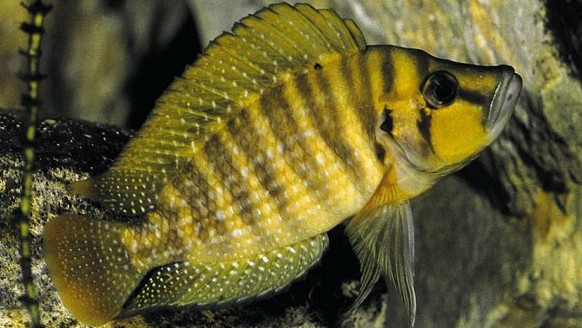
The average adult male is 6 inches while the average adult female is 4.7 inches. The Calvus Cichlid has a laterally compressed body allowing it to enter small crevices and gaps in rocks and makes it very hard to spot head-on. It also has very thick scales with serrated edges which can be used against attackers, a sloped forehead, stripes on the head and collar region, white spots in the posterior flanks and a scaleless area on the head, hence the name “calvus”.
To keep these fish in captivity the water temperature should be between 75.2ºF and 82.4ºF and the pH should range from 8.0 to 8.8. The tank should have lots of piles of rocks, caves and dim light. It is peaceful and can be kept in a community aquarium, however, this species is a predator so it is not advisable to keep species that can fit in its mouth as tankmates, it is also best to avoid keeping it with aggressive tankmates.
These fish can be kept in pairs or as a colony in a suitably sized tank. In the wild, there are many color morphs like black, white and yellow. However, it is best not to keep different color morphs in the same tank to avoid hybridization.
Diet & nutrition
This species is carnivorous. In the wild, they feed on small fish, juveniles, fry, and eggs. In captivity they can be fed with live or frozen food, they can also be fed with dried foods although that isn’t the best diet and won’t bring a female into breeding condition.
Determining sex
Males are larger and have larger fins than females.
Breeding & spawning
This species only reach sexual maturity when they are two years old. They are substrate spawners. The female lays her eggs in a cave that only she can fit in, the male will then release his sperm at the entrance of the cave, and the pair will fan the sperm towards the eggs inside. The eggs hatch in 2 to 4 days and the fry become free swimming in about ten days. At this time you should remove the male parent from the tank because he may pray on the fry, larger fry may also predate on smaller fry. This species can be bred in a community aquarium, but for a better result, it should be bred in a separate aquarium.
Diseases
This species is susceptible to Malawi bloat if its dietary needs aren’t met.
Origination
This species can be found in Lake Tanganyika, Africa. It inhabits the rocky shores of the lake.
Cautions
These fish are very sensitive to changes in water chemistry.
Acclimation process
When first introduced, these fish will spend most of their time hiding and may seem to not eat much; it is important not to overfeed them to avoid degrading the water conditions.
Related articles
These will pull posts tagged to this species (not tied to the species record).
All photos
Tap a photo to open the gallery viewer.