Australian Rainbow
Melanotaenia fluviatilis
Featured guide
This will pull the most popular / featured article tagged to this species.
Water parameters
Water parameters are being added.
About Australian Rainbow
General information
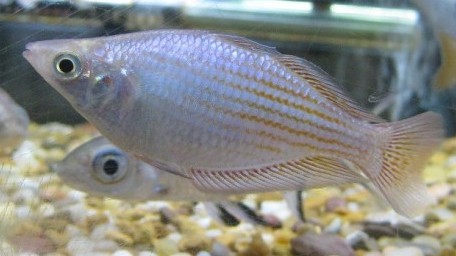
They are brownish olive and sometimes slightly turquoise with reddish fins and can reach up to 4 inches. To keep these fish in captivity, water pH should be between 6.5 and 8.0 and water temperature should range from 68°F to 77°F. The tank should have dense vegetation, hiding places, open areas for swimming and a small gravel substrate. They are very peaceful and can be kept in community aquariums with similar sized tankmates, also they should be kept in shoals of at least 6 and it is very important to keep a good gender ration to keep peace among them.
Diet & nutrition
This species is omnivorous. In the wild it feeds on aquatic invertebrates. In captivity it can be fed with dried food supplemented with live foods like worms and brine shrimp and vegetable matter.
Determining sex
Adult males are larger and more colorful than females.
Breeding & spawning
To breed this species in captivity the fish should be fed lots of live food, also, the breeding tank should have water temperature around 74°F. They will spawn on plants and once they finish spawning the adults should be separated from the eggs to prevent them from eating the eggs. They fry will take a week to hatch.
Origination
This species is native to Queensland and New South Wales, Australia. It inhabits slow moving rivers and streams with dense vegetation.
Acclimation process
The water in which these fish are packaged is different from the water in the tank, since these fish are extremely sensitive to water conditions the acclimation process is very important. This process should never be rushed. Aquarium lights should be off for at least the first 4 hours of the fish in the new tank and it should not be fed in the first 24h. There are two acclimation methods: Floating Method and the Drip Method.
Floating method - the aquarium lights should be off and lights in the room should be dim, the bag in which the fish is should be placed in the surface of the water to float for about 15 minutes, this allows the water in the bag to adjust to the water in the tank. The bag should then be cut under the knot and the top edge of the bag should be rolled down one inch, then ¼ cup of the aquarium water should be added to the bag, this step should be repeated every 4 minutes until the bag is full, then half the water of the bag should be discarded and the bag should be put to float again and ¼ cup of the aquarium water should be added to the bag every 4 minutes until the bag is full. Afterwards, the Discus can be moved into the aquarium.
Drip method – the aquarium lights should be off and lights in the room should be dim, the bag in which the fish is should be placed in the surface of the water to float for about 15 minutes, this allows the water in the bag to adjust to the water in the tank. The bag contents should be poured into a 1 gallon bucket that has never been cleaned with any chemicals, the fish should be enterally submerged. A siphon, using airline tubing, should be set up and a drip line should run from the main aquarium to the bucket. Several loose knots should be tied in the airline tubing to regulate flow. Sucking the end of the airline tube that goes to the bucket will begin a siphon, the flow should be regulated to 2 to 4 drips per second. Once the water in the buckets doubles, half should be discarded and the process should be repeated until it doubles again. Afterwards, the fish can be moved to the aquarium.
Related articles
These will pull posts tagged to this species (not tied to the species record).
All photos
Tap a photo to open the gallery viewer.