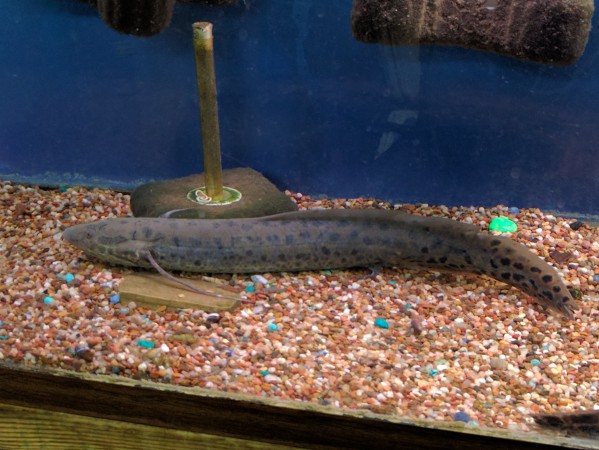
African Lungfish
Protopterus annectens annectens
Featured guide
This will pull the most popular / featured article tagged to this species.
Water parameters
Water parameters are being added.
About African Lungfish
General information
These fish have soft scaled and elongated bodies like eels, they have pectoral fins that look like primitive limbs and allow them to crawl on land. African Lungfish also have gills and lungs, the gills allow them to breathe underwater, however, the fish still have to go to the surface to breathe atmospheric air. They can weight almost 25 pounds. Their natural habitat has a dry season, as such, these fish developed many adaptations to deal with the absence of water. When the dry season comes and the water begin to recede, these fish will find a nesting site among dense vegetation where they will dig into the muddy substrate in order to create a chamber where they will spend the dry season. Once the water is completely gone and they are exposed to air, they excrete large amounts of mucous to cover themselves. These fish then enter aestivation, this means they enter in a state of dormancy in which their metabolic rate decreases. They remain like this until the it is rainy season again.
To keep these fish in captivity, water temperature should be between 76ºF and 86ºF and water movement should be kept to a minimum. The tank should have some large, smooth rocks, branches and a muddy or sandy bottom. The tank should be extremely large and have a cover, it is very important for this cover to be well secured so the fish can’t move it as they will try to escape, a 6 inch layer of air should be left between the cover and the surface of the water. These fish are large and can bite big pieces of other fish, they are also very aggressive towards their own and so individuals should be kept alone.
Diet & nutrition
This species is carnivorous. In the wild it feeds on fish, shellfish and amphibians. In captivity it can be fed with live foods like prawn, mussels, insects, worms and fish. Dried foods aren’t recommended since it may refuse to eat them.
Breeding & spawning
There are no records of breeding in captivity. In the wild, these fish reproduce in swamps during the wet season. They build nests where they lay their eggs and the male is the one to look after them. The eggs take 8 days to hatch and the young leave the nest after 20 days.
Origination
This species can be found in many African countries like Ivory Coast, Niger, Gambia and Chad.
Related articles
These will pull posts tagged to this species (not tied to the species record).
All photos
Tap a photo to open the gallery viewer.