
Regal Angelfish
Pygoplites diacanthus
Saltwater Fish
Species Group: Angel Large
Family: Pomacanthidae
Log in or create an account to add this species to your tanks.
Water parameters
Temp
76-80 F
Temperature
Maintaining a stable and appropriate temperature is critical for the survival of aquatic life.
pH 7.8 - 8.4 potential of HydrogenMeasuring the acidity or alkalinity of water on a 0–14 scale, where 7 is neutral, 7 is alkaline.
NO3 1-20 ppm NitrateWhile less toxic than ammonia, high nitrate levels (above 40–80 ppm) are important to monitor because they can cause fish stress, stunted growth, and harmful algae blooms.
NO2 <0.0001 ppm NitriteIt is a highly toxic, intermediate compound in the nitrogen cycle produced from broken-down ammonia
PO4 0.01 - 0.1 ppm PhosphateIt is essential for plant development but must be managed, as excess levels trigger nuisance algae blooms and inhibit coral calcification.
NH3 <0.1 ppm AmmoniaIt is the primary killer of aquarium fish, causing gill damage, stress, and death
Ca 380 - 450 ppm CalciumSupporting the growth, skeletal structure, and shell formation of corals, mollusks, crustaceans, and coralline algae
KH 8 - 12 dKH AlkalinityIt acts as a shield, neutralizing acids to prevent dangerous pH "crashes" that can harm fish, corals, and plants.
Mg 1200 - 1400 ppm MagnesiumIt enables coral growth by supporting skeletal formation, assists in metabolic processes, and ensures that calcium is available for corals, clams, and coralline algae.
SG 1.023 - 1.026 SG SalinityEssential for maintaining stable, natural water parameters, proper osmoregulation, and stress-free environments for marine fish and corals
ORP 250 - 400 mV Oxidation-Reduction PotentialA higher positive mV indicates clean, oxygen-rich water with high water quality, while low readings indicate high pollution.
About Regal Angelfish
General information
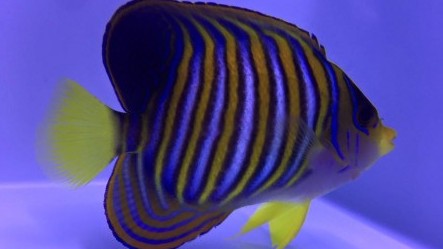
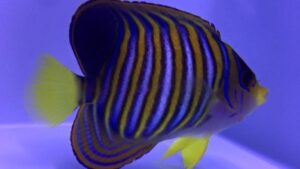
With vivid vertical striations of blue, white, yellow, or orange on the body and pelvic fin, the Regal Angelfish deserves this distinctive name. Regal Angelfish from the Maldives and the Red Sea have a distinctive yellow breast, where their Indo-Pacific, Coral Sea, and Tahitian relatives normally have a blue/gray breast. This coloration is more prevalent in specimens that are more mature and are at least 4" in length. Regal Angelfish from the Red Sea, Maldives, Coral Sea, Fiji and Tahiti are good shippers and are harvested and handled with care, and normally will adapt more easily than their Indo-Pacific counterparts to the home aquarium. The Regal Angelfish is more difficult to maintain than other species of angels so it should be introduced first so that it may stake out its territory in advance of other fish. A large tank with plenty of hiding places and live rock for grazing will offer a good environment. The Regal Angelfish may nip at large-polyped stony corals, an occasional soft coral and clam mantles, but may be kept with small-polyped stony corals and somewhat noxious soft corals.
Diet & nutrition
Regal angelfishes are carnivores and are known to feed on sponges and tunicates. In an aquarium setting, they are known to thrive on a varied diet consisting of food items such as nori seaweed, mysis shrimp, and chopped meaty fare.
Determining sex
The species is hermaphroditic and can change gender from female to male when the need arises.
Origination
Regal angelfish are widely distributed in the Indo-Pacific region ranging from the Red Sea and East Africa to the Tuamoto Islands, north to Ryukyu and Ogasawara Islands in Japan, south to Great Barrier Reef and New Caledonia.
Cautions
These angelfishes are very sensitive to detioriorating water conditions. A reef-type aquarium is ideal because it provides the rocky reef structure that the fish requires to feel secure. Regal angelfishes are also known to pick on corals particularly to large-polyped stony corals such as Trachyphyllia or certain soft coral such as Xenia. They will not thrive in an aquarium with aggressive feeders or fish with belligerent personalities, such as triggerfish and large wrasses.
Acclimation process
The regal angelfish are very sensitive during transportation and acclimatizing in the tank. They should be added in mature tanks with live rocks where they can graze and hide when feeling threathened.
Articles

All photos
Tap a photo to open the gallery viewer.