
Queen Angelfish
Holacanthus ciliaris
Saltwater Fish
Species Group: Angel Large
Family: Pomacanthidae
Log in or create an account to add this species to your tanks.
Water parameters
Temp
76-80 F
Temperature
Maintaining a stable and appropriate temperature is critical for the survival of aquatic life.
pH 7.8 - 8.4 potential of HydrogenMeasuring the acidity or alkalinity of water on a 0–14 scale, where 7 is neutral, 7 is alkaline.
NO3 1-20 ppm NitrateWhile less toxic than ammonia, high nitrate levels (above 40–80 ppm) are important to monitor because they can cause fish stress, stunted growth, and harmful algae blooms.
NO2 <0.0001 ppm NitriteIt is a highly toxic, intermediate compound in the nitrogen cycle produced from broken-down ammonia
PO4 0.01 - 0.1 ppm PhosphateIt is essential for plant development but must be managed, as excess levels trigger nuisance algae blooms and inhibit coral calcification.
NH3 <0.1 ppm AmmoniaIt is the primary killer of aquarium fish, causing gill damage, stress, and death
Ca 380 - 450 ppm CalciumSupporting the growth, skeletal structure, and shell formation of corals, mollusks, crustaceans, and coralline algae
KH 8 - 12 dKH AlkalinityIt acts as a shield, neutralizing acids to prevent dangerous pH "crashes" that can harm fish, corals, and plants.
Mg 1200 - 1400 ppm MagnesiumIt enables coral growth by supporting skeletal formation, assists in metabolic processes, and ensures that calcium is available for corals, clams, and coralline algae.
SG 1.023 - 1.026 SG SalinityEssential for maintaining stable, natural water parameters, proper osmoregulation, and stress-free environments for marine fish and corals
ORP 250 - 400 mV Oxidation-Reduction PotentialA higher positive mV indicates clean, oxygen-rich water with high water quality, while low readings indicate high pollution.
About Queen Angelfish
General information
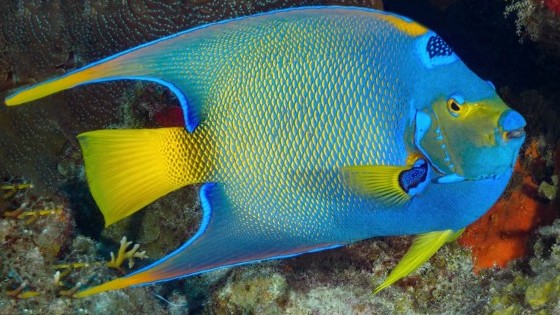
The Queen Angelfish is one of the most striking of all angelfish. Vibrant yellow and electric sapphire-blue highlights give the Queen Angelfish an almost iridescent appearance. It has a dark spot on the forehead surrounded by bright blue. The dorsal and pelvic fins are elongated. With the potential of reaching an impressive 18 inches, the Queen Angelfish needs a large tank, with lots of hiding places and live rock for grazing. Not a good reef dweller, the Queen Angelfish is prone to nip at stony and soft corals (sessile invertebrates) and clam mantles. It can be aggressive, so it must be introduced to the community tank last. A somewhat difficult angelfish to keep, Queen Angelfish often suffer from incorrect water parameters and diet. The Small Juvenile will contain the Juvenile colorations or may be color shifting to a young adult, while the Medium will be a sub-adult, and the Large will be in Adult coloration.
Diet & nutrition
Queen angelfish feed primarily on sponges, but may also feed on tunicates, jellyfish and corals as well as plankton and algae. Juvenile Queen angelfishes are also known 'cleaners' feeding on the parasites of larger fishes. In the aquarium it is recommended that they are fed with a diet consisting of Spirulina, seaweed or nori, some meaty fare such as krill, mysis shrimp, or crabs, and prepared food made with sponge material. Live rocks with mature algae may also serve as food supplement for this species in the tank.
Determining sex
Males are generally larger than the female.
Breeding & spawning
Queen angelfishes have not yet been bred in captivity. In the wild, Queen angelfishes were observed to be polygamous with 1 male to 4 female ratio. They are known to spawn during winter months. Courting behavior usually starts when a male shows off his pectoral fin to the female by flicking them outward every few seconds. The female then ascends to the water column as the male positions himself below her to nuzzle her vent area to release their sperm and eggs. Spawning usually occurs within minutes of sunset during the evening. Fertilization then occurs and eggs will hatch after 15-20 hours.
Diseases
The Queen angelfish are hardy fishes in captivity. If not stressed, they have a stronger immune system to prevent common infections such as White Spot disease, Velvet disease, or Lymphocystis which is a viral infection that can cause a nodule growth on the fins and mouth of the angelfish preventing it from eating.
Origination
The Queen angelfish is a subtropical insular species found in the reefs surrounding offshore islands often limited to the tropical western Atlantic region. It ranges from the waters of Bermuda to Brazil, and from Panama to the Winward Islands. It is found to be abundant thoughout theCarribean.
Cautions
Queen angelfish are moderately aggressive species requiring large aquarium anywhere from 150 to 180 gallons. They may harrass similar sized angelfish and passive fishes like anthias, batfish, tilefish and butterflyfish, nor with slow moving or stationary fish like frogfishes and scorpionfishes. This angelfish should be added last in the tank.
Acclimation process
The Queen angelfishes should be added in tanks with mature live rocks as additional food supplement. Water conditions in the tank should be kept at high quality of 72 to 82 F temperature, pH level of 8, ,and with moderate water movement and lighting.

All photos
Tap a photo to open the gallery viewer.