
Fuelleborni Cichlid, Orange Blossom
Labeotropheus fuelleborni
Freshwater Fish
Species Group: African Cichlids
Family: Cichlidae
Log in or create an account to add this species to your tanks.
Water parameters
Water parameters are being added.
About Fuelleborni Cichlid, Orange Blossom
General information
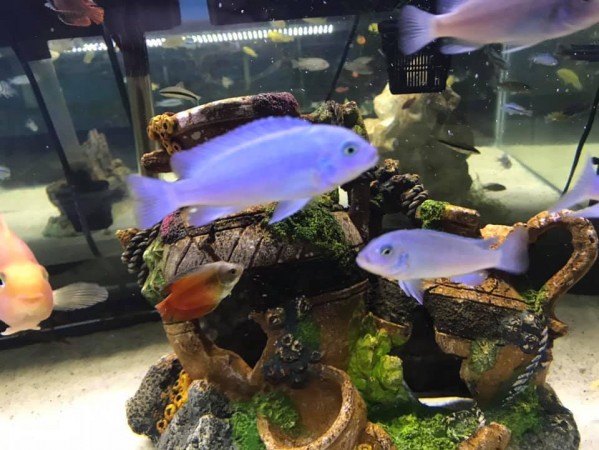
These fish have an overhanging snout, chisel-shaped teeth for grazing algae from rocks and can reach 7 inches. Males are dark blue with orange fins but can change their colors to a lighter blue when stressed or excited. To keep this species in an aquarium, the water should be well oxygenated, have a pH between 7.8 and 8.6 and temperatures ranging from 75ºF to 82ºF. The tank should have a sandy substrate, plenty of rocks, caves and open area to swim. They are very territorial and can even be aggressive towards other species. However, they can be kept in a community tank with other Mbuna. This species should never be in the same aquarium as Labeotropheus trewavasae to avoid hybridization. They are quite aggressive against their species, however, overcrowding the tank helps to dissipate the aggression.
Diet & nutrition
This species is omnivorous. In the wild, it feeds on the rock’s biofilm, algae and small fish. In an aquarium, they should be fed with vegetable matter like spirulina flakes and Romain Lettuce.
Determining sex
Males are blue while females are brownish-gray with orange stripes ( marmalade).
Breeding & spawning
The male will clean his chosen spawning site and then display his colors to get a female’s attention. Once a female is interested, she will approach the spawning site and lay her eggs, pick them up in her mouth, follow the egg spots on the male’s anal fin and the male will release his sperm fertilizing the eggs in her mouth. The female will carry the eggs for 3 to 4 weeks, not eating for this entire period. The fry are free swimming when released from her mouth and can be fed with brine shrimp. To breed this species in captivity, there should be three females for one male. The water pH should be around 8.2- 8.5, temperatures should be between 77ºF and 80ºF, and flat stones and areas of open sand should be provided.
Origination
This species can be found in Lake Malawi, Africa. It inhabits turbulent, well-oxygenated, shallow waters in the rocky shorelines.
All photos
Tap a photo to open the gallery viewer.