Saltwater

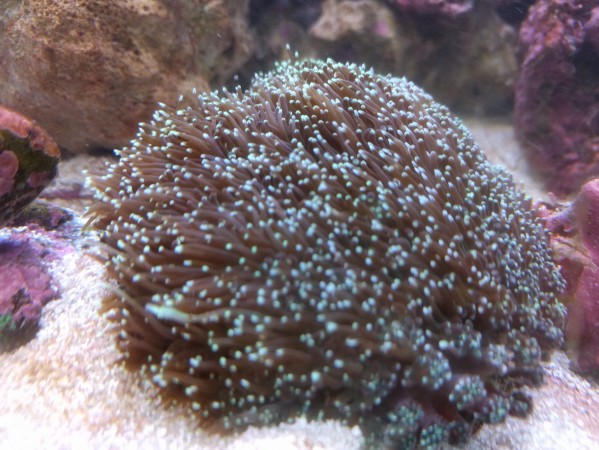
  • Spit Fire Leptastrea

    General information In general, corals from genus Leptastrea usually takes the form of encrusting to massive types. They have corallites that are cerioid in shape and colonies that are flat and angular. Their septa has a distinct cycle pattern that forms granulated sides and margins. They are one of the species of corals where their…

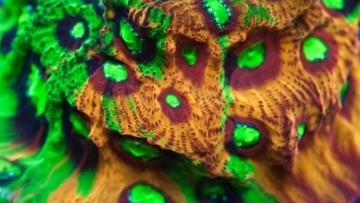
  • Juicy Red Acan

    General information This is the ideal range of water parameters for raising Juicy Red Acan in captivity: Calcium: 400 – 450 ppm Alkalinity: 3.2 – 4.8 MEQ/L Phosphates: 0 Magnesium: 1200 – 1350 Strontium: 8 – 10 Temperature: 76° – 83° F (24° – 28° C) Salinity / Specific Gravity: 1.023 – 1.025

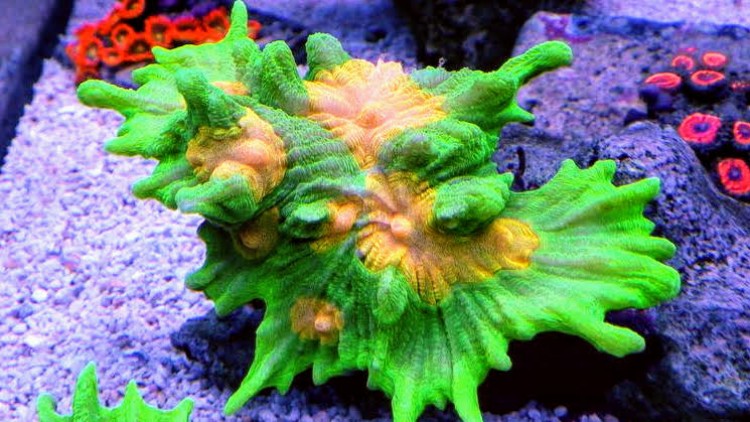
  • Masterpiece Fungia

    General information In general, corals coming from the genus Fungia are solitary animals. Unlike your typical coral, Fungia coral is not composed of a colony, but instead, is a  single-polyp coral. It has a flattened skeletal structure that resembles like a disc. Its corallite walls are highly elevated forming plates and their mouth is located…

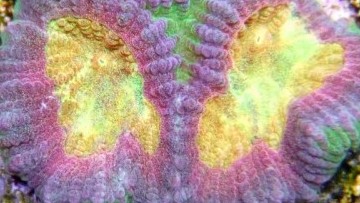
  • Mystic Grape Favia

    General information In general, the genus Favia have large coral colonies that are circular in shape and comes in the form of massive, submassive and encrusting type. At a first glance, you can mistakenly identify Favia with Favites. However, with a closer look, Favia and Favites can easily be differentiated. Favites have corallite walls that…

  • Orange Rimmed Fungia

    General information In general, corals coming from the genus Fungia are solitary animals. Unlike your typical coral, Fungia coral is not composed of a colony, but instead, is a  single-polyp coral. It has a flattened skeletal structure that resembles like a disc. Its corallite walls are highly elevated forming plates and their mouth is located…

  • Gold Torch Euphyllia

    General information In general, corals from the genus Euphyllia have long tentacles that may stretch out 2 to 4 inches and are usually extended out most of the time. When the polyps are retracted, you can clearly see that each corallite is completely separated from each other and is encased by its own wall. For…

  • Red Acanthastrea lordhowensis

    General information Naturally, Red Acanthastrea lordhowensis are massive types of reef-building corals. They have compressed corallites with an uneven height and acute walls with thick septa and large teeth. They don’t develop columns, instead, they have a fleshy mantle that is covered by fine papillae. Their color ranges from red, purple to green and you…

  • Orange Delight Acan Echinata

    General information In the wild, Orange Delight Acan Echinata comes in two forms: either encrusting or massive. Their colonies may reach over a meter in length. They have circular corallites with thick walls and septa that have long and pointed teeth. Their skeleton is covered with a dense, fleshy tissue that usually forms a concentric…

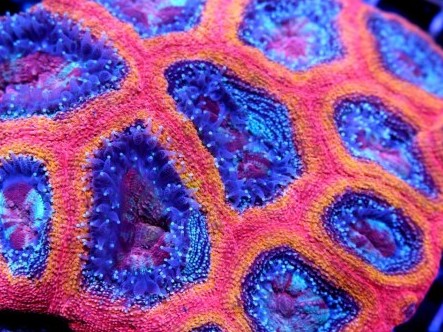
  • Romels Rainbow Cyphastrea

    General information In general, species from Cyphastrea are fast growing when you compare it to other mound-building corals. They usually grow in an encrusting form and can visually see a difference in size within 6 months. Newbies can cultivate Cyphastrea since they are easy to care and maintain. They can grow in a wide range…