Saltwater

  • 7 Star OPP Micromussa

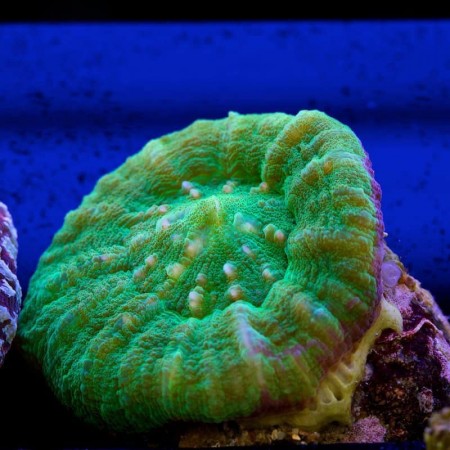
    General information In the wild, corals coming from the genus Micromussa have colonies that takes the encrusting and massive forms. Their colonies have several corallites that are cerioid in nature and are neatly arranged in an angular pattern. They have a thick mantle that is often fleshy and covered with several papillae. For the 7 Star…
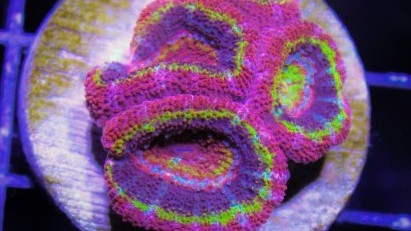
  • Double Down Hammer Euphyllia

    General information In general, corals from the genus Euphyllia have long tentacles that may stretch out 2 to 4 inches and are usually extended out most of the time. When the polyps are retracted, you can clearly see that each corallite is completely separated from each other and is encased by its own wall. For…

  • Black Hole Sun Acan

    General information You also have to look out for other factors and must stay within the range: Calcium: 400 – 450 ppm Alkalinity: 3.2 – 4.8 MEQ/L Phosphates: 0 Magnesium: 1200 – 1350 Strontium: 8 – 10 Temperature: 76° – 83° F (24° – 28° C) Salinity / Specific Gravity: 1.023 – 1.025

  • Candy Apple Scolymia

    General information In general, corals coming from the genus Scolymia are round solitary corals that has a single mouth located at the center. Their coloration usually has an alternating radial bands with a cup, saucer, flat or dome shaped variations. As for the Candy Apple Scolymia, they are predominantly colored green with yellow perpendicular lines….

  • Bleeding Apple Bower Acan

    General information You also have to look out for other factors and must stay within the range: Calcium: 400 – 450 ppm Alkalinity: 3.2 – 4.8 MEQ/L Phosphates: 0 Magnesium: 1200 – 1350 Strontium: 8 – 10 Temperature: 76° – 83° F (24° – 28° C) Salinity / Specific Gravity: 1.023 – 1.025

  • Dragon Soul Prism Favia

    General information In general, the genus Favia have large coral colonies that are circular in shape and comes in the form of massive, submassive and encrusting type. At a first glance, you can mistakenly identify Favia with Favites. However, with a closer look, Favia and Favites can easily be differentiated. Favites have corallite walls that…

  • Green Frosty Acan

    General information This is the ideal range of water parameters for raising Green Frosty Acan in captivity: Calcium: 400 – 450 ppm Alkalinity: 3.2 – 4.8 MEQ/L Phosphates: 0 Magnesium: 1200 – 1350 Strontium: 8 – 10 Temperature: 76° – 83° F (24° – 28° C) Salinity / Specific Gravity: 1.023 – 1.025

  • Kaliedoscope Brain Coral

    General information In general, corals coming from the genus Goniastrea have polyps that are seldom exposed, except during night. Their corallites with walls that are fused and common, where it collectively looks like a brain and this its name. This are the water parameters for cultivating Kaliedoscope Brain Coral Goniastrea: Calcium: 400 – 450 ppm…

  • Golden Eye Chalice

    General information In general, species from Echinophyllia has an encrusting growth where their colonies can form folds or cups. The corallites that are located at the middle are usually elevated with warty bumps. The color of their mouth usually has a different color from their fleshy body. For the Golden Eye Echinophyllia, they are predominatly…

  • Quad Color Echinata

    General information In the wild, Quad Color Echinata comes in two forms: either encrusting or massive. Their colonies may reach over a meter in length. They have circular corallites with thick walls and septa that have long and pointed teeth. Their skeleton is covered with a dense, fleshy tissue that usually forms a concentric fold. For…