Saltwater

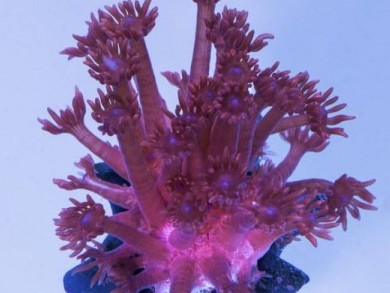
  • Ruby Red Goni

    General information In general, corals coming from the genus Goniopora have numerous corallites that are walled invidually. Each corallite has a polyp that is usually exposed and extended. Their polyps are usually long, has a daisy-like tips each having 24 tentacles and sways like a flower tube. As for the Ruby Red Goniopora planulata, they…
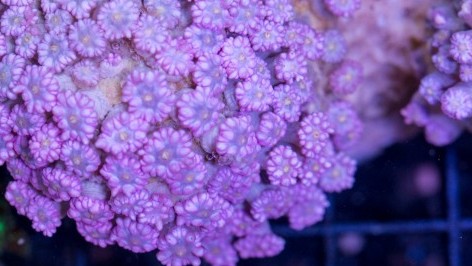
  • Lakers Goni

    General information In general, corals coming from the genus Goniopora have numerous corallites that are walled invidually. Each corallite has a polyp that is usually exposed and extended. Their polyps are usually long, has a daisy-like tips each having 24 tentacles and sways like a flower tube. As for the Lakers Goni, they are predominantly…

  • Strawberry Shake Fungia

    General information In general, corals coming from the genus Fungia are solitary animals. Unlike your typical coral, Fungia coral is not composed of a colony, but instead, is a  single-polyp coral. It has a flattened skeletal structure that resembles like a disc. Its corallite walls are highly elevated forming plates and their mouth is located…

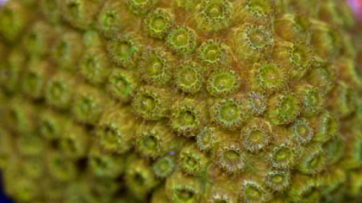
  • Golden Eye Cyphastrea

    General information In general, species from Cyphastrea are fast growing when you compare it to other mound-building corals. They usually grow in an encrusting form and can visually see a difference in size within 6 months. Newbies can cultivate Cyphastrea since they are easy to care and maintain. They can grow in a wide range…

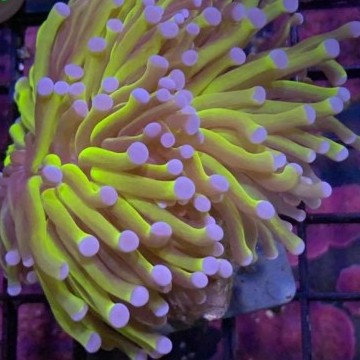
  • Aussie Gold Torch Euphyllia

    General information In general, corals from the genus Euphyllia have long tentacles that may stretch out 2 to 4 inches and are usually extended out most of the time. When the polyps are retracted, you can clearly see that each corallite is completely separated from each other and is encased by its own wall. For…

  • Melting Ultra Favia

    General information In general, the genus Favia have large coral colonies that are circular in shape and comes in the form of massive, submassive and encrusting type. At a first glance, you can mistakenly identify Favia with Favites. However, with a closer look, Favia and Favites can easily be differentiated. Favites have corallite walls that…

  • Vice Favia

    General information In general, the genus Favia have large coral colonies that are circular in shape and comes in the form of massive, submassive and encrusting type. At a first glance, you can mistakenly identify Favia with Favites. However, with a closer look, Favia and Favites can easily be differentiated. Favites have corallite walls that…