Saltwater

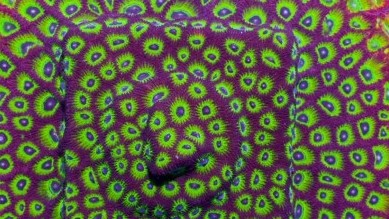
  • Solar Flare Favia

    General information In general, the genus Favia have large coral colonies that are circular in shape and comes in the form of massive, submassive and encrusting type. At a first glance, you can mistakenly identify Favia with Favites. However, with a closer look, Favia and Favites can easily be differentiated. Favites have corallite walls that…

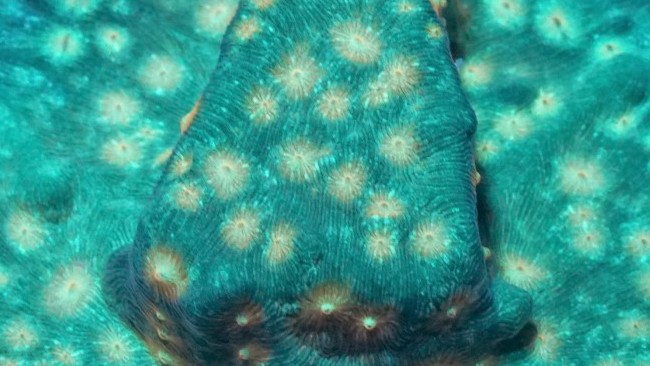
  • Manhattan Project Acan

    General information The Manhattan Project Acan has a pronounced columnae; its corallite is colored dark blue to violet while the mouth has an orange-green color. This is the ideal range of water parameters for raising Manhattan Project Acan in captivity: Calcium: 400 – 450 ppm Alkalinity: 3.2 – 4.8 MEQ/L Phosphates: 0 Magnesium: 1200 –…

  • Mystic Blueberry Ice Favia

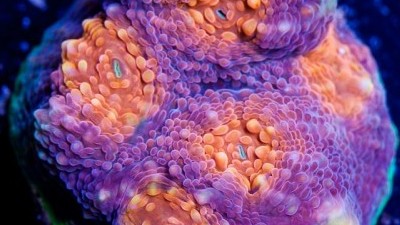
    General information In general, the genus Favia have large coral colonies that are circular in shape and comes in the form of massive, submassive and encrusting type. At a first glance, you can mistakenly identify Favia with Favites. However, with a closer look, Favia and Favites can easily be differentiated. Favites have corallite walls that…

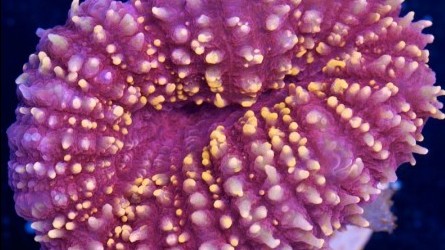
  • Orange Rim Diasaris Plate Fungia

    General information In general, corals coming from the genus Fungia are solitary animals. Unlike your typical coral, Fungia coral is not composed of a colony, but instead, is a  single-polyp coral. It has a flattened skeletal structure that resembles like a disc. Its corallite walls are highly elevated forming plates and their mouth is located…

  • Pirates Booty Favia

    General information In general, the genus Favia have large coral colonies that are circular in shape and comes in the form of massive, submassive and encrusting type. At a first glance, you can mistakenly identify Favia with Favites. However, with a closer look, Favia and Favites can easily be differentiated. Favites have corallite walls that…

  • Devils Eye Favia

    General information In general, the genus Favia have large coral colonies that are circular in shape and comes in the form of massive, submassive and encrusting type. At a first glance, you can mistakenly identify Favia with Favites. However, with a closer look, Favia and Favites can easily be differentiated. Favites have corallite walls that…

  • Fanta Smash Acan Echinata

    General information In the wild, Fanta Smash Acan Echinata comes in two forms: either encrusting or massive. Their colonies may reach over a meter in length. They have circular corallites with thick walls and septa that have long and pointed teeth. Their skeleton is covered with a thick fleshy tissue that usually forms a concentric…

  • Neon Green Duncan

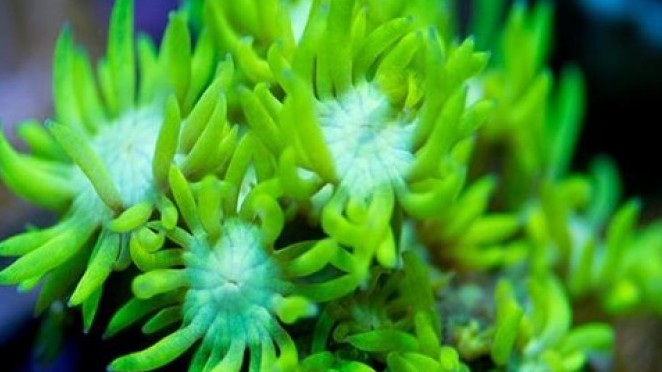
    General information Duncanopsammia are tall and standing corals. They have a columnar type of exoskeleton where each of their polyp are located terminally or at the end. Each of its polyps has a single set of mouth located at the center. They can take several lifeforms and shapes over its lifetime where the bushy form…

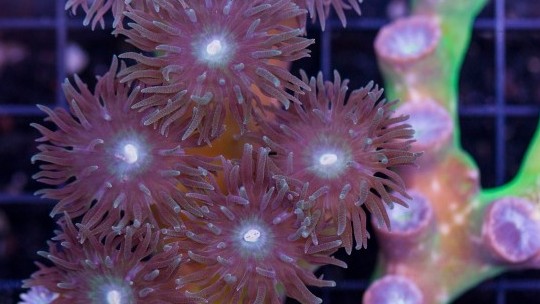
  • Pink Goni

    General information In general, corals coming from the genus Goniopora have numerous corallites that are walled invidually. Each corallite has a polyp that is usually exposed and extended. Their polyps are usually long, has a daisy-like tips each having 24 tentacles and sways like a flower tube. As for the Pink Goni, they are predominantly…