
Gold Rabbit Snail
Tylomelania gemmifera
Freshwater Invertebrate
Species Group: Snail
Family: Pachychilidae
Log in or create an account to add this species to your tanks.
Water parameters
Water parameters are being added.
About Gold Rabbit Snail
General information
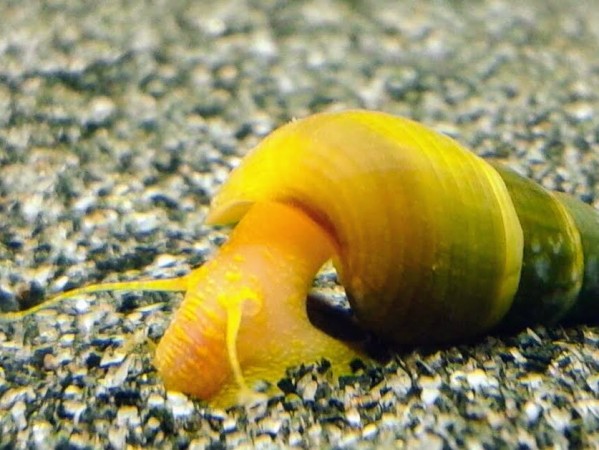
Gold rabbit snails also are known as elephant snail or rabbit snail comes from Indonesia and very rare in the United States. Its name come from its appearance. Gold rabbit snail has a bunny “face,” with an elongated head, drooping yellow antennae “ears,” and a long, downturned mouth. Gold Rabbit Snails possess bodies with a luminous and sunny yellow coloration, and their shells are black or very dark brown and sometimes feature a white crown. In addition to the bright attractive color of the Gold Rabbit Snail, they are a fascinating creature to watch. They are always in action mood in the aquarium. With its appearance, gigantic size and behavior, they are one of the most attracted species of its kind.
Their shells are long and spiral-shaped and taper toward a point at the end, which makes the shell resemble unicorn’s horn in shape. These snails seem curious by nature, and each snail uses its elongated, muscular “foot” to pull itself around on the glass and aquarium decor. A Rabbit Snail shell looks similar to the cone-shaped shells of Trumpet Snail and Assassin Snails. And Rabbit Snails have a small operculum used for defense, but unlike a Japanese Trap Door Snail, it covers only a portion of their aperture.
They are known to live up to 3 years, sometimes even longer if appropriately treated with special attention. Despite the average size of this snail is 3 inches, as older the Rabbit Snail is, the longer it will be, all things equal. They are one of the largest freshwater snails in the world, growing as large as 5 inches as adults. Since they can grow so large, they need room to move, so it’s a good idea to avoid dense vegetation or overcrowding in your aquarium. They are decent algae-eaters, but they also feed on leftover food and any kind of fish food. While most aquatic plants are safe from these snails, they have been known to munch on more delicate or thin-leaved plants.
Rabbit snails are pretty unique in their way and differ from other snails quite a bit with their characteristic behavior and appearance. Perhaps one of the most unique features of Rabbit snails is their constant state of action. They love to wander and explore, and you better be ready to give them some awesome environment to explore. If you spectate them long enough, you will realize how sloppy they may be in their movement, but that’s sort of what makes them fun and entertaining to watch. There’s an endless amount of fun to be had just watching these fellas do their thing. Despite their attractive and lively behavior, rabbit snails are very much peaceful creatures. They’re very peaceful creatures so keep them only in combination with other peaceful species like shrimp, snails and other non-aggressive fish.
Although a Rabbit Snail is pretty active, it is not uncommon for them to rest motionless for long periods of time. When resting, their bodies will be curled up into their shells and their operculum will be pulled into their aperture. Just because the Rabbit Snail is not moving on the tank bottom, it does not necessarily mean it is dead or dying.
As mentioned earlier, rabbit snails grow pretty big, and they love to wander around and explore – so make sure you give them enough space to do so. Aquarium of 30+ gallons should be enough for them. 10 gallons per snail is recommended. Make sure it’s pretty spacey so they can travel around freely without running across some obstacles. Give them lots of durable plants, logs, and rocks; some stone slabs could be useful as they love to hide under them. As for the substrate, give them something soft like sand and mud – they love to move around in a soft substrate, but some will prefer to stick with the rocks.
Since they come from a very tropical, hot place – make sure the water is always warm. A temperature of about 75-85 °F (25-30°C) works the best, with higher pH levels of about 7.5 – 8.5 to avoid shell erosion. As for the lighting, make sure it’s a little bit darker than usual as they don’t like to be exposed to bright light. Because of that, you will often find them hiding behind plants and rocks, looking for peace and calm.
It is a good idea to keep tank water on the on the hard side so minerals are present for healthy shell growth. To that end, offering food supplements with Calcium is a good idea too. Recommended KH level is between 2 – 15 dKH.
Another Rabbit Snail care issue involves the hazards of canister or power filter intakes. A Rabbit Snail may get its head or foot caught in the slots of filter intakes. If this happens, the snail may not be able to back itself out and begin become seriously injured or even killed. So its prudent to keep filter intakes covered with coarse sponge pre-filters to prevent accidents.
Diet & nutrition
A Rabbit Snail is a good scavenger, a ferocious eater and they seem very interested in eating some forms of soft algae growing on hard surfaces. Rabbit Snails also seem to be interested in eating decaying plant matter that has fallen to the bottom of the tank. But their diet should not be limited to the naturally occurring foods in a tank. A Rabbit Snail should also be offered food supplements, especially those rich in Calcium. Hobbyists can try things like bottom feeder pellets, algae wafers, and fish flakes for starters. Other food sources can be blanched green leafy vegetables such as lettuce, cucumber, and spinach, as well as blanched green zucchini.
All snails do better when calcium is part of their diet so make sure yours have access to this in the form of a supplement, food or treatment.
They eat a lot so make sure you feed them often to keep them well-fed and happy. As said earlier, they exhibit scavenger-like behavior, so you can expect them to run around the tank looking for leftover food but cannot thrive simply on a diet of left-overs. They need to be offered a healthy, balanced diet.
Since they eat plants, they might eat your live plants inside the aquarium. Make sure your decor plants are strong and durable, so these pesky little snails don’t mess with them. Hobbyist often reports that Rabbit Snails are interesting in eating Java Ferns. But other than Java Ferns, keeping Rabbit Snails well fed on a balanced diet of green leafy supplements, as well as keeping them with plants like Anubias with strong, durable leaves, plants should be relatively safe.
Breeding & spawning
It is not uncommon for Rabbit Snail breeding to occur in freshwater tanks provided conditions are right. The good news is that Rabbit Snail breeding happens slowly Compared to most of the other snail species who lay a ton of eggs and crowd the space – rabbit snails are quite slow breeders. A Rabbit Snail produces one offspring at a time, so the tank does not get overrun like with many other snails.
Female rabbit snails usually carry around 1 to 3 eggs and will slowly release them one by one. After breeding, you may notice a creamy white trail behind the females, and soon enough eggs will also appear. Inside the eggs, there are already fully formed, young rabbit snails waiting to pop out and when they do – you can expect them to quickly roam around looking for food, truly living up to their reputation. One of the nice things to observe about a baby Rabbit Snail is how flawless its shell appears. No pit marks or scuffs, just a well-formed whorl from apex to the aperture.
Origination
They come from freshwater lakes of Sulawesi, Indonesia.
Cautions
It is important to keep Ammonia and Nitrite levels at 0 ppm, and Nitrate levels in check as well. As with other freshwater snails, be careful with medications and plant fertilizers, as snails may be sensitive to them. And this is especially true with Copper. Copper can be harmful or fatal to Rabbit Snails. Many commercial fish foods, medications, and plant fertilizers contain copper or more commonly copper sulfate. Always look at the ingredient list for any product going into the aquarium to ensure they are copper free.
It is a good idea to keep tanks covered to the extent possible. Although a Rabbit Snail may not be the escape artist as Mystery Snail is, it is possible they can make their way out of the tank, become injured and die.
All photos
Tap a photo to open the gallery viewer.