
Blue Spotted Angelfish
Chaetodontoplus caeruleopunctatus
Saltwater Fish
Species Group: Angel Dwarf
Family: Angelfish
Log in or create an account to add this species to your tanks.
Water parameters
Temp
76-80 F
Temperature
Maintaining a stable and appropriate temperature is critical for the survival of aquatic life.
pH 7.8 - 8.4 potential of HydrogenMeasuring the acidity or alkalinity of water on a 0–14 scale, where 7 is neutral, 7 is alkaline.
NO3 1-20 ppm NitrateWhile less toxic than ammonia, high nitrate levels (above 40–80 ppm) are important to monitor because they can cause fish stress, stunted growth, and harmful algae blooms.
NO2 <0.0001 ppm NitriteIt is a highly toxic, intermediate compound in the nitrogen cycle produced from broken-down ammonia
PO4 0.01 - 0.1 ppm PhosphateIt is essential for plant development but must be managed, as excess levels trigger nuisance algae blooms and inhibit coral calcification.
NH3 <0.1 ppm AmmoniaIt is the primary killer of aquarium fish, causing gill damage, stress, and death
Ca 380 - 450 ppm CalciumSupporting the growth, skeletal structure, and shell formation of corals, mollusks, crustaceans, and coralline algae
KH 8 - 12 dKH AlkalinityIt acts as a shield, neutralizing acids to prevent dangerous pH "crashes" that can harm fish, corals, and plants.
Mg 1200 - 1400 ppm MagnesiumIt enables coral growth by supporting skeletal formation, assists in metabolic processes, and ensures that calcium is available for corals, clams, and coralline algae.
SG 1.023 - 1.026 SG SalinityEssential for maintaining stable, natural water parameters, proper osmoregulation, and stress-free environments for marine fish and corals
ORP 250 - 400 mV Oxidation-Reduction PotentialA higher positive mV indicates clean, oxygen-rich water with high water quality, while low readings indicate high pollution.
About Blue Spotted Angelfish
General information
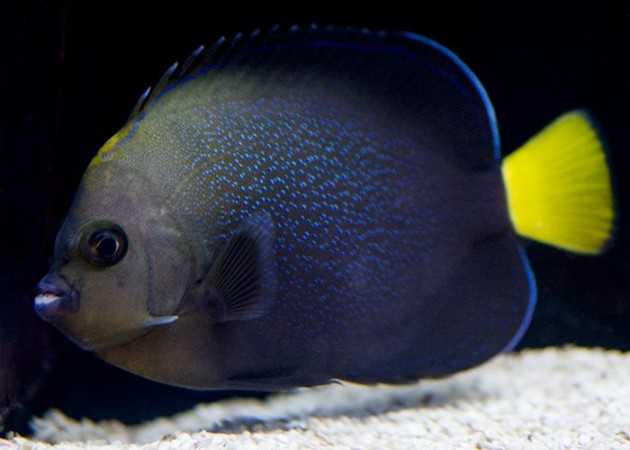
The Blue Spotted Angelfish, aka Blue-Spangled Angelfish is named as such due to the powder blue spots that cover its gray body. Its tail is yellow, and the anal and dorsal fins are edged in black. It is a reef-associated non-migratory species found in coastal reefs at fairly shallow depths ranging from 15 to 40 m.
Chaetodontoplus caeruleopunctatus can reach a maximum adult size of 6 inches. This species is collected for the aquarium trade but is rarely exported. It is a rare species known only from one specimen caught off Cebu Island in 1972.
Diet & nutrition
C. caeruleopunctatus is known to be omnivorous, feeding on sponges and tunicates. In tank conditions, Blue Spotted Angelfishes may be fed with diatoms, spirulina, and other angelfish food preparations. Frozen food such as shrimp and other meaty nutrients can be added to their diet. Further, flake foods shuch as Nori may be added to their diet.
Feeding the Blue Spotted Angelfishes must be done at least 3 times a day to avoid nipping on soft corals or clam mantles.
Determining sex
All the members of the genus Chaetodontoplus are protogynous hermaphrodites which means that they change sex from female to male at sexual maturity or when the need arises. Size is a usual differentiating characteristic in protogynous hermaphrodites, where male a relatively larger than the female fishes.
Breeding & spawning
Blue Spotted Angelfishes often grouped into harems with 1 dominating male individual and 3 to 4 female angelfishes. Courtship begins at dusk when male soars above the female, hovers with his fins extended, and tilts at a 45-90 degree angle from the bottom. When the female is ready to spawn, it follows the male and initiates spawning with a mutual soaring display.
The gametes are then released into the water column for external fertilization.
Diseases
Angelfishes such as the Blue Spotted Angelfish might be able to contract common bacterial diseases such as Cotton wool disease, Vibrio bacterial disease, and Fish tubercolosis. Cotton wool disease is exhibited as an expanding translucent layer that eats away on the skin. Vibrio Bacterial disease on the other hand are exhibited by Dropsy, Popeye, Bleeding or Red Streaks on the skin. Lastly, Fish T.B. usually shows up as a loss of color and swelling of the body. It can also display blood streaks and blood spots anywhere in the body.
Aside from bacterial diseases, angelfishes my be affected by common reef scourges such as the Crypt or White Spot Diseases and Velvet Disease. Tiny white spots on the skin of the fish is one of the tell-tale sign of infection of the Crypt while dusty golden film on the skin or the eyes of the angelfish will detect the presence of Velvet Disease.
Origination
Blue spotted angelfishes are endemic in the reefs of the Philippines. However, it can be found to be distributed in the West Pacific Ocean.
Cautions
Depending on its tankmate it can be quite shy when first entering the aquarium and may hide in caves and crevices. Blue spotted angelfishes should be combined with other non-aggressive aquarium mates that has a calm character such as community fish like tangs, clownfish, damsels, gobies, blennies, butterflies and similar fishes. Smaller fish might get harassed when added with Blue spotted Angelfishes. Angelfishes should not be kept with other angelfishes in aquariums to avoid territorial conflicts. Species with same coloration should not be in the same aquarium.
It is best that they are kept in tanks 90-125 gallons in size to avoid the need to attack everyone that happens to swim by and to avoid nipping on hard and soft corals, and clam mantles.
Acclimation process
The aquarium where the Blue Spotted angelfish will be kept should have sufficient hiding places and live rocks to hide in if they feel threatened. Acclimation time for this species is about 30 minutes. In adding the Blue spotted angelfish in an aquarium, the smallest and most docile individual should be added first followed by the largest and most aggressive individual. It may nip at soft corals, stony corals, and mantles of tridacnid clams, hence larger aquaria or fish only aquaria is recommended for these species.
All photos
Tap a photo to open the gallery viewer.