
Vermiculated Angelfish
Chaetodontoplus mesoleucus
Saltwater Fish
Species Group: Angel Large
Family: Pomacanthidae
Log in or create an account to add this species to your tanks.
Water parameters
Temp
76-80 F
Temperature
Maintaining a stable and appropriate temperature is critical for the survival of aquatic life.
pH 7.8 - 8.4 potential of HydrogenMeasuring the acidity or alkalinity of water on a 0–14 scale, where 7 is neutral, 7 is alkaline.
NO3 1-20 ppm NitrateWhile less toxic than ammonia, high nitrate levels (above 40–80 ppm) are important to monitor because they can cause fish stress, stunted growth, and harmful algae blooms.
NO2 <0.0001 ppm NitriteIt is a highly toxic, intermediate compound in the nitrogen cycle produced from broken-down ammonia
PO4 0.01 - 0.1 ppm PhosphateIt is essential for plant development but must be managed, as excess levels trigger nuisance algae blooms and inhibit coral calcification.
NH3 <0.1 ppm AmmoniaIt is the primary killer of aquarium fish, causing gill damage, stress, and death
Ca 380 - 450 ppm CalciumSupporting the growth, skeletal structure, and shell formation of corals, mollusks, crustaceans, and coralline algae
KH 8 - 12 dKH AlkalinityIt acts as a shield, neutralizing acids to prevent dangerous pH "crashes" that can harm fish, corals, and plants.
Mg 1200 - 1400 ppm MagnesiumIt enables coral growth by supporting skeletal formation, assists in metabolic processes, and ensures that calcium is available for corals, clams, and coralline algae.
SG 1.023 - 1.026 SG SalinityEssential for maintaining stable, natural water parameters, proper osmoregulation, and stress-free environments for marine fish and corals
ORP 250 - 400 mV Oxidation-Reduction PotentialA higher positive mV indicates clean, oxygen-rich water with high water quality, while low readings indicate high pollution.
About Vermiculated Angelfish
General information
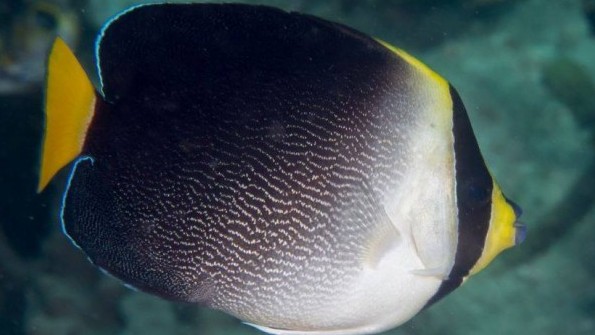
The Singapore Angelfish has been likened to a butterflyfish in body structure. Blue lips and a yellow nose abruptly change to a black vertical band over the eyes, resembling a mask. The mask is bordered with another thin vertical band of yellow, followed by a wider vertical band of white with the body being primarily black. Dorsal and anal fins are outlined in brilliant sapphire-blue and the caudal fin is usually yellow but may be gray. The Singapore Angelfish can be challenging to keep. Some acclimate well, while others hide constantly and do not eat. Providing a quietly located aquarium with non-aggressive tank mates and plenty of hiding places may help. A large tank with live rock for grazing will also help provide an optimal environment. The Singapore Angelfish is prone to nip at stony and soft corals (sessile invertebrates) and clam mantles. It will also graze on microalgae, filamentous algae, and diatoms.
Diet & nutrition
The Singapore Angelfish are omnivores that feed primarily on benthic algae and seaweed but is also observed to feed on sponges, tunicates, and filamentous algae. In the tank, these angels may be fed with a mix of meaty and pelletized food. Diet should consist of prepared food with Spirulina content, and meaty fare such as mysis shrimp and shredded fresh or frozen shrimp. They may also be fed with filamentous algae and diatoms.
Determining sex
There are no determining morphological characteristics for this species. However, like other angelfish, it is usually the larger sized individuals that turns out to be male.
Breeding & spawning
Not yet bred in captivity, however in the wild, the Vermiculated Angelfish starts courtship just before sunset. The male will swim above the female, tilts his body and extends his fins, awaiting for a response from the female. When ready, the female will swim towards the area which the male designated as their spawning area. The pair will then soar above the water column as the male nuzzles the female belly. Simultaneously, both will release their gametes into the water column for fertilization.
Diseases
They are highly susceptible to Marine Ich (Cryptocaryon irritans) when stressed by other fish, bad water quality, or when relocated. Symptoms consists of constant scratching which ends to lots of white dots. The dots may disappear for a couple of days only to return with double the number. This will then lead to the suffocation of the fish caused by the parasites blocking the gills from providing oxygen.
It may also contract a viral infection, Lymphocystis, which are small cauliflower-shaped nodules in the fins and mouth, which may prevent it from eating for a prolonged period of time.
Origination
The Vermiculated angelfish are widely distributed in the Indo-West Pacific region ranging from Japan to Indonesia, Sri Lanka and east to Papua New Guinea and also reported to be seen in Mentawai Island.
Cautions
This species are known to eat tubeworms and may nibble on clam mantles. These angels aren't the most aggressive animal in their family, but they still don't like other fish that are the same size and shape.
They may be housed with peaceful and semi-aggressive fishes like cardinalfish, gobies, tilefish, damselfish, butterflyfish, fairy basslets, and wrasses.
Acclimation process
Tank conditions must be kept pristine at all times. The Vermiculate angelfish should be kept in tanks with a minimum size of 100 gallons with plenty of live rocks and algae. They acclimate best when introduced in tanks as juveniles. To encourage feeding, the fish may be presented with caulerpa or a freshly opened clam or mussel or live feeder mysis or brine shrimp to initiate a feeding response. Keeping the tank area quiet is also important to encourage the angelfish to come out to feed.

All photos
Tap a photo to open the gallery viewer.