
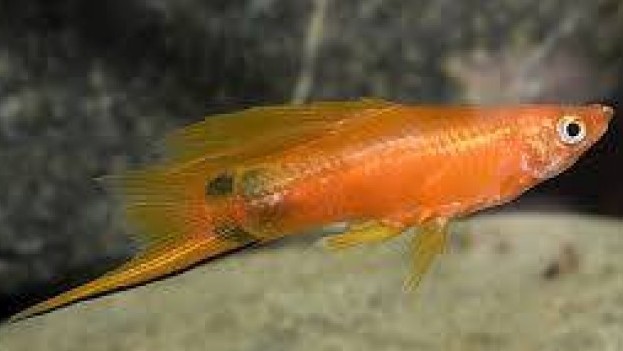
Red Mickey Mouse Swordtail
Xiphophorus hellerii
Freshwater Fish
Species Group: Swordtails
Family: Poeciliidae
Log in or create an account to add this species to your tanks.
Water parameters
Water parameters are being added.
About Red Mickey Mouse Swordtail
General information
The Swordtail is an active hardy aquarium fish that can easily be recognized from the sword like tail fin of a male sepicemen. Thanks to the selective breeding and hybridization numerous varieties with different colors and fin types excist in the aquarium hobby. With their unique characteristics, they are truly fun to keep and offer a wonderful sight for almost every aquarist. The Swordtail or Green Swordtail is in the aquarium hobby for a relatively long time. They are mentioned in aquatic magazines as early as 1950s. While wild forms are olivish green and grey with parallel brown and black stripes, domestic types’ colors range from orange, red to black. Males tend to be slender and smaller than the females. The swordtail’s length could reach 3.5–16 cm (1.4–6.3 in) depending on the particular varieties. Their lifespan can reach up to 4 years if they are properly taken care of.
Diet & nutrition
Swordtails are omnivores. They feed on worms, crustaceans, insects, insect larvae, algae and other plant matter in their natural environment. They are not picky eaters in the aquariums and they would happily take all kinds of food that is provided such as dry, flake, pellet, frozen and live. They also like to swim around the tank to find some edible delicacies such as algae and fish fry.
Determining sex
Adult males have extended caudal fin extension resembling a sword while females lack of it. Like most of the livebearers the gender of the Swordtail can be identified by looking the anal fins. Though females have normal anal fins, males have pointed fin close the anal area that is called gonopodium. Surprisingly this species tends to go through sex reversal (from female to male) under certain environmental circumstances.
Breeding & spawning
Swordtails are prolific breeders and ready to breed at home aquariums. After the mating, the female gives birth to 20 - 200 juveniles that are literally small copies of their mother, following a gestation period of 28 to 42 days. The fry is immediately active and vigorous so they can swim around and take care of themselves. Mother should not be left alone with the fries as she can see no problem devouring her young. Dense plantation and plenty of hiding places help young swordtails maintain their life. Swordtails mature between nine to twelve months. Young males may develop gonopodium and sword like tail lately and can be wrongly sexed as females.
Diseases
Although generally a hardy fish species, swordtails can be susceptible to dropsy, white spot disease, fish fungus and other diseases related to inbreeding. Taking precautions is always easier and cheaper than treating fish when it gets sick. Keeping your water clean, housing proper number of fish, lowering the stress in the tank, being careful about compatibility would help to keep them healthy.
Origination
This livebearer fish belongs to family of Poecilidae of order Cyprinodontiformesis and native to Mexico and Northern Central America yet feral populations are reported in Africa and several other countries. Austrian zoologist and ichthyologist Johann Jakob Heckel is the first describer of this species. Hellerii is named after Austrian botanist and naturalist Karl Bartholomaeus Heller who is a collector of this species. They are closely related to platyfish (Xiphophorus maculatus). Xiphophorous hellerii can be found primarily in fast flowing watercourses, rivers, canals and ponds that are rich with water plants and other vegetation in the nature. They can become accustomed to live in both fresh and brackish water.
Cautions
Despite they are peaceful to the other aquarium dwellers; males are territorial and fight with other males to gain control of the females. Avoiding such a struggle could be prevented by offering plenty of hiding places –if the tank is big enough- or choosing the ratio of 1 male to 4-5 females. For the reason that they are decent jumpers, top of the tank should properly be covered. Making sudden movements and interferences to the tank -such scraping the glass very fast suddenly or rushing to catch a fish with a net- may also stress the Swordtail out and it can attempt to leap out of the tank.
Acclimation process
Swordtails are good candidates for community tanks if the tank mates are carefully chosen. They enjoy the heavily planted and well aerated tank which has lower nitrate levels. The ideal water temperature is between 23 and 27 degrees Celsius, the ideal pH is from 7.0 to 8.5.
All photos
Tap a photo to open the gallery viewer.