
Foxface Lo
Siganus vulpinus
Saltwater Fish
Species Group: Rabbitfish
Family: Siganidae
Log in or create an account to add this species to your tanks.
Water parameters
Temp
76-80 F
Temperature
Maintaining a stable and appropriate temperature is critical for the survival of aquatic life.
pH 7.8 - 8.4 potential of HydrogenMeasuring the acidity or alkalinity of water on a 0–14 scale, where 7 is neutral, 7 is alkaline.
NO3 1-20 ppm NitrateWhile less toxic than ammonia, high nitrate levels (above 40–80 ppm) are important to monitor because they can cause fish stress, stunted growth, and harmful algae blooms.
NO2 <0.0001 ppm NitriteIt is a highly toxic, intermediate compound in the nitrogen cycle produced from broken-down ammonia
PO4 0.01 - 0.1 ppm PhosphateIt is essential for plant development but must be managed, as excess levels trigger nuisance algae blooms and inhibit coral calcification.
NH3 <0.1 ppm AmmoniaIt is the primary killer of aquarium fish, causing gill damage, stress, and death
Ca 380 - 450 ppm CalciumSupporting the growth, skeletal structure, and shell formation of corals, mollusks, crustaceans, and coralline algae
KH 8 - 12 dKH AlkalinityIt acts as a shield, neutralizing acids to prevent dangerous pH "crashes" that can harm fish, corals, and plants.
Mg 1200 - 1400 ppm MagnesiumIt enables coral growth by supporting skeletal formation, assists in metabolic processes, and ensures that calcium is available for corals, clams, and coralline algae.
SG 1.023 - 1.026 SG SalinityEssential for maintaining stable, natural water parameters, proper osmoregulation, and stress-free environments for marine fish and corals
ORP 250 - 400 mV Oxidation-Reduction PotentialA higher positive mV indicates clean, oxygen-rich water with high water quality, while low readings indicate high pollution.
About Foxface Lo
General information
The Foxface Lo has a unique body color. It has a mottled yellow-brown body with a dark chest. The face is very light in color and speckled on the lower half. They are a very hardy fish and are great additions to the newly-established tank. It may reside in a large aquarium and typically reaches 7” to 9” total length. It is a very peaceful species except when housed with other rabbitfish. The Foxface Lo may be housed with more aggressive fish. Its predators will tend to leave it alone because of its venomous dorsal spines.
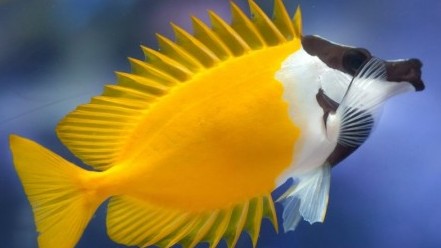
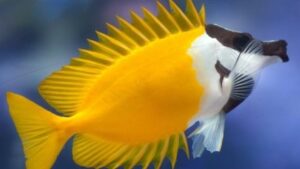
Easily recognized by its distinctive shape and coloration, it has an elongated snout (typical of the rabbitfish family) and a striking bright yellow body. Its head is white, with a large black triangle on its breast, a diagonal black ocular band from the first dorsal fin spine to the chin, and a narrow white blaze down the front of its snout. These unique head markings give rise to one of the Foxface’s common names: badger fish.
They retain this bright coloring throughout the day and during the night (or when stressed), have the ability to change into a mottled dark brown/gray/white pattern. Besides changing color, they are often found stationary in strange places, such as tank corners, perched in coral, vertical along a coral or rock, or even molded or curved to match the contour of a rock. This dramatic change is undoubtedly used as camouflage against predators, and upon waking, or when no longer stressed, their bright colors quickly return. Foxface’s are so adept at this camouflage, that they can easily be missed by the aquarist and yet be in plain view.
Although Foxface’s are compatible with most other fish, regardless of size, it can get stressed out by any fish that habitually bullies it. Tangs of the genus Zebrasoma will sometimes bully the Foxface, Tangs will see a Foxface as a direct food competitor. If you plan to keep a Foxface with Tangs it is suggested that you add the Foxface first to your aquarium.
Although they typically travel in pairs in the ocean, only one specimen should be kept per aquarium unless the tank is quite large.
Diet & nutrition
An omnivore by nature, you may find it difficult to discover what a Foxface won't eat. They have voracious appetites and aggressive eaters when it come to feeding time. The Foxface Lo will accept a wide range of meaty seafood and just about every plant it can find. Besides grazing on algae, the Foxface enjoys a variety for its diet which includes the occasional nori (dried seaweed), frozen spirulina and even blanched green veggies to its diet.
The Foxface should be considered “semi-reef safe”, it has been reported from time to time to nip at corals (they seem to have an eye for zooanthids and button polyps) when hungry. However, if well-fed Foxface typically won’t mess with your corals.
Specimens that appear pinched behind the head in the dorsal area are malnourished.
Diseases
The Foxface sometimes tends to get a few scrapes, which heal within a day or two, although they should be watched for signs of secondary bacterial infection. It should also be noted that the Foxface will occasionally shed its slime coat which is one of the reasons why it's so disease resistance.
Origination
denizen of the Indo-Pacific shallow reefs and lagoons
Cautions
Rabbitfish are generally reef-safe if they are well fed. If not, it is possible for them to nip at and consume some species of LPS and soft corals.
Acclimation process
Upon initial acclimation, Foxfaces tend to be rather timid, often spending the first week or two in hiding. They will gradually venture out more freely but may be easily startled back into hiding when you walk up to or past the tank. This may last up to a few months, however, if provided with plenty of rockwork, the fish will acclimate more quickly. Once acclimated, the Foxface will spend the majority of the day swimming in the open, as well as throughout the rockwork, pausing to graze on whatever algae it finds along the way.
Articles
All photos
Tap a photo to open the gallery viewer.