
Ghost Bandit Angelfish
Apolemichthys arcuatus
Saltwater Fish
Species Group: Angel Dwarf
Log in or create an account to add this species to your tanks.
Water parameters
Temp
76-80 F
Temperature
Maintaining a stable and appropriate temperature is critical for the survival of aquatic life.
pH 7.8 - 8.4 potential of HydrogenMeasuring the acidity or alkalinity of water on a 0–14 scale, where 7 is neutral, 7 is alkaline.
NO3 1-20 ppm NitrateWhile less toxic than ammonia, high nitrate levels (above 40–80 ppm) are important to monitor because they can cause fish stress, stunted growth, and harmful algae blooms.
NO2 <0.0001 ppm NitriteIt is a highly toxic, intermediate compound in the nitrogen cycle produced from broken-down ammonia
PO4 0.01 - 0.1 ppm PhosphateIt is essential for plant development but must be managed, as excess levels trigger nuisance algae blooms and inhibit coral calcification.
NH3 <0.1 ppm AmmoniaIt is the primary killer of aquarium fish, causing gill damage, stress, and death
Ca 380 - 450 ppm CalciumSupporting the growth, skeletal structure, and shell formation of corals, mollusks, crustaceans, and coralline algae
KH 8 - 12 dKH AlkalinityIt acts as a shield, neutralizing acids to prevent dangerous pH "crashes" that can harm fish, corals, and plants.
Mg 1200 - 1400 ppm MagnesiumIt enables coral growth by supporting skeletal formation, assists in metabolic processes, and ensures that calcium is available for corals, clams, and coralline algae.
SG 1.023 - 1.026 SG SalinityEssential for maintaining stable, natural water parameters, proper osmoregulation, and stress-free environments for marine fish and corals
ORP 250 - 400 mV Oxidation-Reduction PotentialA higher positive mV indicates clean, oxygen-rich water with high water quality, while low readings indicate high pollution.
About Ghost Bandit Angelfish
General information
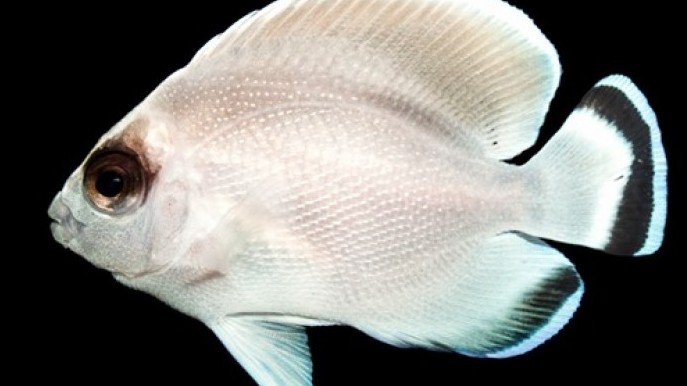
Ghost Bandit Angelfishes are commonly found on rocky reefs, in ledges and caves, and in coral areas. Visually, these angelfish are overall pale with a broad black bar bordered by a narrow pearly white band running across the upper side from the front of the eye to the posterior portion of the soft dorsal fin. A similar broad black band with pearly white border runs submarginal on the caudal and anal fins.
These dwarf angels are usually found in depth ranges of 25 to 50 m and may even reach up to 183 m. Hence when owning one is such a spectacular, rare, and very distinctive angelfish.
Diet & nutrition
Ghost bandit angelfish heavily rely on sponges with some algal matter for their diet in the wild. Hence, specimen from this species are difficult to maintain in an aquaria because of its specialized sponge and algal diet.
Determining sex
Just like other marine angelfish, the Ghost Bandit Angelfish are protogynous hermaphrodites. They are born as females and will have sex reversal at adult stage for reproduction. Male Ghost Bandit Angelfish are usually larger than the female. This fish usually occurs in harems where a male is often in charge of many female, that when the male dies the next dominant female turns to assume the new male leader of the harem.
Breeding & spawning
Breeding of ghost bandit angelfish in home aquarium has been deemed as difficult but several aquaculture center has bred this species in captivity on a couple of occasions.
Diseases
Ghost bandit angelfish are delicate aquarium fish and is very sensitive during transportation. Hence, this dwarf angel may be able to contract physical ailments easily such as difficulty in decompressing. Physical ailments may include a bloated abdomen.
Some divers when collecting this species use a procedure called "needling" which pierces a small hole in the fish's air bladder to decompress, this may lead to complications such as bacterial infection. One major bacteria of concern is the Vibrio bacteria. It usually starts as an infection that turns into Dropsy, Popeye, Bleeding or Red Streaks on the skin. It is a very fast acting bacteria that can kill the fish within two days.
Origination
Ghost Bandit Angelfish are endemic to the Hawaiian Islands and in Johnston Atoll.
Cautions
It is not compatible to reef tanks, it survives best in fish-only-live-rock (FOLR) tanks since it is known to bite on sessile invertebrates such as sponges, stony and soft corals, and clam mantles. Ghost bandit are quite aggressive and territorial, hence it best to keep in large tanks to avoid competition for space and territory.
Ghost Bandit angelfish are known to have short lifespans when kept in an aquarium due to their sensitivity. Hence, they should be kept in optimal conditions for their survival
Acclimation process
In acquiring this individual for a tank, it is recommended that they are introduced as juveniles since it will acclimatize better in aquarium condition when introduced young.
Since Ghost Bandit angelfishes are used to faint light in natural conditions, it is recommended that tank light should be dimmed first when introducing the specimen and gradually increasing it to normal for acclimization. Also this species can be very shy when first introduced into the aquarium, once acclimatized more aggressive fish can be added into the tank.
Adequate amount of established living rocks with micro-invertebrates should be included to provide enough grazing, hiding, and swimming space to keep the fish active and healthy.
All photos
Tap a photo to open the gallery viewer.