
Upside Down Catfish
Synodontis nigriventris
Freshwater Fish
Species Group: Catfish
Family: Mochokidae
Log in or create an account to add this species to your tanks.
Water parameters
Water parameters are being added.
About Upside Down Catfish
General information
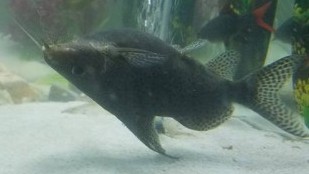
The average adult is 4 inches. This species is adapted to spend its time upside-down, as it ages it spends more and more time in this position. This adaption has consequences on its coloration; the belly is darker than the dorsal area of the body working as camouflage against predators above. To keep Synodontis nigriventris in captivity the water should be between 71.6ºF and 82.4ºF, the aquarium should be dimly lit, have a soft substrate and plenty of hiding places where it can get some refuge, these fish like to have its belly pressed up against a surface, so it is advisable to have some bogwood and branches. This species is peaceful and can be kept in a community aquarium as long as none of its tankmates is a potential predator or prey. It is advisable to keep it in groups of at least 3, it can be kept as a single specimen, but the individual will spend most of its time hiding and won’t be active at all, a group of 2 isn’t recommended because one will dominate the other through constant aggression.
Diet & nutrition
This species is omnivorous. In the wild, it feeds mainly on invertebrates and vegetable matter. As a nocturnal species, it feeds at night. In an aquarium, it can be fed with floating pellets, flakes, plant matter, mosquito larvae, and live or frozen brine shrimp. Unlike many other Synos, S. nigriventris feeds from the surface in an upside-down position.
Determining sex
Females are wider, rounder and paler than males.
Breeding & spawning
In the wild, they breed during the rainy season, so it is likely that changes in the water conditions induce spawning behavior. Not much is known about their breeding in captivity. However, it is known that they lay their eggs in depressions in the substrate or caves, that there is no parental care, that the parents will eat their fry and that the fry starts swimming upside-down after 7-8 weeks.
Origination
This species can be found in Congo and Cameroon, Africa. It inhabits densely vegetated riverbanks.
Cautions
This species has pectoral and dorsal spines that can kill its predators and tankmates that try to eat it; these spines can become easily entangled in the mesh of nets, so it is best to move them in plastic containers.
These fish doesn’t tolerate poor water quality, so frequent water changes are recommended. It also doesn’t tolerate the presence of salt in water which can easily kill them.
All photos
Tap a photo to open the gallery viewer.