
Rainbow Cichlid
Herotilapia multispinosa
Freshwater Fish
Species Group: New World Cichlids
Family: Cichlidae
Log in or create an account to add this species to your tanks.
Water parameters
Water parameters are being added.
About Rainbow Cichlid
General information
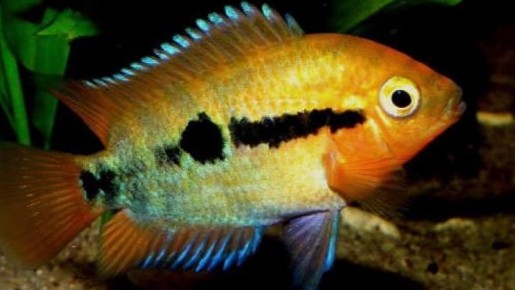
These fish are gold and have black markings and tints of blue. They can reach up to 7 inches, however, they rarely exceed 4 inches in captivity. To keep these fish in captivity, water temperature should range from 72°F to 77°F and water pH should be between 7.0 and 8.0. The tank should have a sandy or muddy substrate, plants, rocks and hiding places. They are peaceful and can be kept in community aquariums with similar sized species, also, they can be kept singly or in pairs, a 20 gallon tank is the minimum recommended for a pair.
Diet & nutrition
This species is omnivorous. In the wild it feeds mainly on detritus. In captivity, it can be fed with flakes, insects and shrimps. It is recommended to supplement their diet with vegetable matter like peas or spirulina.
Determining sex
Males are larger and have more pointed fins than females.
Breeding & spawning
To breed this species in captivity, the breeding tank should have water pH around 7.0 and water temperature around 82°F. The pair will start by cleaning the spawning site, then the female will lay her eggs and the male will fertilize them. Eggs take 2 days to hatch and the fry become free-swimming a week later.
Origination
This species is native to Honduras, Nicaragua and Costa Rica. It inhabits turbid waters with muddy substrates.
Acclimation process
The water in which these fish are packaged is different from the water in the tank, since these fish are extremely sensitive to water conditions the acclimation process is very important. This process should never be rushed. Aquarium lights should be off for at least the first 4 hours of the fish in the new tank and it should not be fed in the first 24h. There are two acclimation methods: Floating Method and the Drip Method.
Floating method - the aquarium lights should be off and lights in the room should be dim, the bag in which the fish is should be placed in the surface of the water to float for about 15 minutes, this allows the water in the bag to adjust to the water in the tank. The bag should then be cut under the knot and the top edge of the bag should be rolled down one inch, then ¼ cup of the aquarium water should be added to the bag, this step should be repeated every 4 minutes until the bag is full, then half the water of the bag should be discarded and the bag should be put to float again and ¼ cup of the aquarium water should be added to the bag every 4 minutes until the bag is full. Afterwards, the Discus can be moved into the aquarium.
Drip method – the aquarium lights should be off and lights in the room should be dim, the bag in which the fish is should be placed in the surface of the water to float for about 15 minutes, this allows the water in the bag to adjust to the water in the tank. The bag contents should be poured into a 1 gallon bucket that has never been cleaned with any chemicals, the fish should be enterally submerged. A siphon, using airline tubing, should be set up and a drip line should run from the main aquarium to the bucket. Several loose knots should be tied in the airline tubing to regulate flow. Sucking the end of the airline tube that goes to the bucket will begin a siphon, the flow should be regulated to 2 to 4 drips per second. Once the water in the buckets doubles, half should be discarded and the process should be repeated until it doubles again. Afterwards, the fish can be moved to the aquarium.
All photos
Tap a photo to open the gallery viewer.