
Flagfin Angelfish
Apolemichthys trimaculatus
Saltwater Fish
Species Group: Angel Large
Family: Pomacanthidae
Log in or create an account to add this species to your tanks.
Water parameters
Temp
76-80 F
Temperature
Maintaining a stable and appropriate temperature is critical for the survival of aquatic life.
pH 7.8 - 8.4 potential of HydrogenMeasuring the acidity or alkalinity of water on a 0–14 scale, where 7 is neutral, 7 is alkaline.
NO3 1-20 ppm NitrateWhile less toxic than ammonia, high nitrate levels (above 40–80 ppm) are important to monitor because they can cause fish stress, stunted growth, and harmful algae blooms.
NO2 <0.0001 ppm NitriteIt is a highly toxic, intermediate compound in the nitrogen cycle produced from broken-down ammonia
PO4 0.01 - 0.1 ppm PhosphateIt is essential for plant development but must be managed, as excess levels trigger nuisance algae blooms and inhibit coral calcification.
NH3 <0.1 ppm AmmoniaIt is the primary killer of aquarium fish, causing gill damage, stress, and death
Ca 380 - 450 ppm CalciumSupporting the growth, skeletal structure, and shell formation of corals, mollusks, crustaceans, and coralline algae
KH 8 - 12 dKH AlkalinityIt acts as a shield, neutralizing acids to prevent dangerous pH "crashes" that can harm fish, corals, and plants.
Mg 1200 - 1400 ppm MagnesiumIt enables coral growth by supporting skeletal formation, assists in metabolic processes, and ensures that calcium is available for corals, clams, and coralline algae.
SG 1.023 - 1.026 SG SalinityEssential for maintaining stable, natural water parameters, proper osmoregulation, and stress-free environments for marine fish and corals
ORP 250 - 400 mV Oxidation-Reduction PotentialA higher positive mV indicates clean, oxygen-rich water with high water quality, while low readings indicate high pollution.
About Flagfin Angelfish
General information
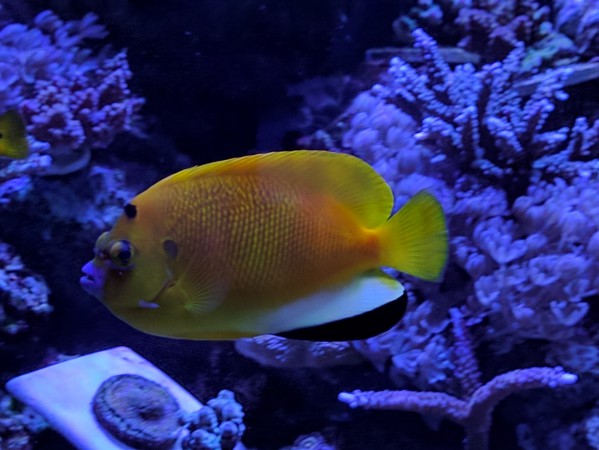
The Flagfin Angelfish is a brilliant yellow with blue lips, a dark blue-black dorsal spot where the head joins the body, and a light tan spot behind the eye. Provide plenty of other hiding places in a large as the Flagfin Angelfish is quite shy early on and should be the only angel in the tank. Not a good reef dweller, the Flagfin Angelfish is prone to nip at sessile invertebrates (soft and stony corals) and clam mantles.
Diet & nutrition
It is an omnivore that primarily eats sponges and tunictaes along with algae. It is best to supplement tank with mysis or brine shrimp to intitiate feeding response on the fish when first introduced in the tank. Once acclimated, prepared food such as those containing spirulina, sponge, algae sheets, chopped fish and shrimp should be provided in small amounts several times per day.
Determining sex
Flagfin angelfish does not show distinct sexual dimorphism. However, males tend to be larger than females.
Breeding & spawning
Flagfin angelfish has been reported to successfully spawn in large public aquarium. These large angelfishes are usually broadcast spawners releasing sperm and eggs at sunset. Courtship for this species usually occurs at dusk, this then progresses to an ascent to the water column by the males followed by females which eventually lead to the release of gametes in the water column for external fertilization. During courtship the male will trail behind the female positioning his snout to near the female's abdomen.
Diseases
In captivity,Flagfin Angelfishes are prone to ite Spot Disease and Velvet Disease which causes blotchy coloration on the dark skin areas. It is also suscetible to viral infection like Lymphocystis which is the formation of cauliflower-shaped nodules on the fins and mouth keeping them from eating properly.
Flagfin angelfishes may also contract monogenetic flukes.
Origination
Apolemichthys trimaculata or Flagfin angelfish are highly distributedi n the Indo-West Pacific covering the south eastern coast of Africa to Samoa, southern part of Japan towards Australia's northern coasts and islands.
Cautions
These angelfish are quite difficult to keep as they are extremely timid and easily stressed. They can be kept in a community aquarium with peaceful tankmates provided that it is large enough to avoid aggressive behavior towards other angelfish in the tank.
Acclimation process
Tanks should be mature, at least 6 months, provided with live rocks for feeding and hiding place before introducing a Flagfin Angelfish in it.
All photos
Tap a photo to open the gallery viewer.