
Watanabei Angelfish
Genicanthus watanabei
Saltwater Fish
Species Group: Angel Large
Family: Pomacanthidae
Log in or create an account to add this species to your tanks.
Water parameters
Temp
76-80 F
Temperature
Maintaining a stable and appropriate temperature is critical for the survival of aquatic life.
pH 7.8 - 8.4 potential of HydrogenMeasuring the acidity or alkalinity of water on a 0–14 scale, where 7 is neutral, 7 is alkaline.
NO3 1-20 ppm NitrateWhile less toxic than ammonia, high nitrate levels (above 40–80 ppm) are important to monitor because they can cause fish stress, stunted growth, and harmful algae blooms.
NO2 <0.0001 ppm NitriteIt is a highly toxic, intermediate compound in the nitrogen cycle produced from broken-down ammonia
PO4 0.01 - 0.1 ppm PhosphateIt is essential for plant development but must be managed, as excess levels trigger nuisance algae blooms and inhibit coral calcification.
NH3 <0.1 ppm AmmoniaIt is the primary killer of aquarium fish, causing gill damage, stress, and death
Ca 380 - 450 ppm CalciumSupporting the growth, skeletal structure, and shell formation of corals, mollusks, crustaceans, and coralline algae
KH 8 - 12 dKH AlkalinityIt acts as a shield, neutralizing acids to prevent dangerous pH "crashes" that can harm fish, corals, and plants.
Mg 1200 - 1400 ppm MagnesiumIt enables coral growth by supporting skeletal formation, assists in metabolic processes, and ensures that calcium is available for corals, clams, and coralline algae.
SG 1.023 - 1.026 SG SalinityEssential for maintaining stable, natural water parameters, proper osmoregulation, and stress-free environments for marine fish and corals
ORP 250 - 400 mV Oxidation-Reduction PotentialA higher positive mV indicates clean, oxygen-rich water with high water quality, while low readings indicate high pollution.
About Watanabei Angelfish
General information
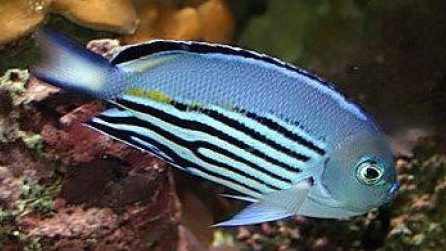
The Watanabe’s Angelfish is one of the few angelfish displaying sexual dimorphism. The male is an iridescent pale blue. The lower half of the body and anal fin of the male are highlighted by long, horizontal dark stripes and one, horizontal orange stripe extending toward the caudal fin. The female is an iridescent pale blue with a dark dorsal fin and does not have stripes other than a dark outline to the dorsal and anal fins. Watanabe’s Angelfish are best housed as a male-female pair in a large tank and are ideal candidates for the deep-water reef aquarium. Acclimation will be facilitated by a dimly-lit tank. The tank should have multiple hiding places and live rock for grazing. Do not keep two males in the same tank as fighting will ensue.
Diet & nutrition
Watanabe's Angelfish primarily feeds on plankton in the wild, as well as pelagic tunicates off the water column. Their teeth and mouth are well adapted in catching floating food particle rather than picking off on algae or coralline growth.
Determining sex
It is one of the few angelfish species that exhibist sexual dimorphism. Like other Genicanthus angels, the Watanabei's angelfish are protogynous hermaphordites that have the ability to change sex from female to male when the need arises. The females are distinguished by a uniform pale steel blue, and are unmarked sans a “crown” consisting of a few black bands near the nape, and black trimming on the dorsal, anal and caudal fin edges. The males are more dramatically coloured, being the same base coloration as the female, but lacking the crown and instead, possessing a series of horizontal black and white stripes across much of its body.
Breeding & spawning
In the wild, the range of certain species overlap and even mix, such as G. lamarck + G. melanospilos, and G. semifasciatus + G. takeuchii etc. The males entice the females when they are ready to mate by swimming on their side and quivering his fins and tail. The most dominant and biggest male will breed more freely and frequently with smaller females.
Origination
In the wild, G. watanabei ranges widely across the Pacific, being found in Japan to the Philippines, South to New Caledonia and the Austral islands and Melansia. In the trade, they are most often caught and offered from the Philippines as well as Coral sea and rarely from Melanesia.
Cautions
This species is known to jump out of open aquaria. It is best kept in aquaria where no other angelfish are too similar with the Watanabei's angelfish to avoid becoming territorial.
Acclimation process
These fish should be kept in a well run aquarium where they can "graze" algae from rocks and stones.
If there are insufficient algae on the rocks, it is important to feed more frequently and supplement with algae rich food e.g. Spirulina.
All photos
Tap a photo to open the gallery viewer.