
Lamarcks Angelfish
Genicanthus lamarck
Saltwater Fish
Species Group: Angel Large
Family: Pomacanthidae
Log in or create an account to add this species to your tanks.
Water parameters
Temp
76-80 F
Temperature
Maintaining a stable and appropriate temperature is critical for the survival of aquatic life.
pH 7.8 - 8.4 potential of HydrogenMeasuring the acidity or alkalinity of water on a 0–14 scale, where 7 is neutral, 7 is alkaline.
NO3 1-20 ppm NitrateWhile less toxic than ammonia, high nitrate levels (above 40–80 ppm) are important to monitor because they can cause fish stress, stunted growth, and harmful algae blooms.
NO2 <0.0001 ppm NitriteIt is a highly toxic, intermediate compound in the nitrogen cycle produced from broken-down ammonia
PO4 0.01 - 0.1 ppm PhosphateIt is essential for plant development but must be managed, as excess levels trigger nuisance algae blooms and inhibit coral calcification.
NH3 <0.1 ppm AmmoniaIt is the primary killer of aquarium fish, causing gill damage, stress, and death
Ca 380 - 450 ppm CalciumSupporting the growth, skeletal structure, and shell formation of corals, mollusks, crustaceans, and coralline algae
KH 8 - 12 dKH AlkalinityIt acts as a shield, neutralizing acids to prevent dangerous pH "crashes" that can harm fish, corals, and plants.
Mg 1200 - 1400 ppm MagnesiumIt enables coral growth by supporting skeletal formation, assists in metabolic processes, and ensures that calcium is available for corals, clams, and coralline algae.
SG 1.023 - 1.026 SG SalinityEssential for maintaining stable, natural water parameters, proper osmoregulation, and stress-free environments for marine fish and corals
ORP 250 - 400 mV Oxidation-Reduction PotentialA higher positive mV indicates clean, oxygen-rich water with high water quality, while low readings indicate high pollution.
About Lamarcks Angelfish
General information
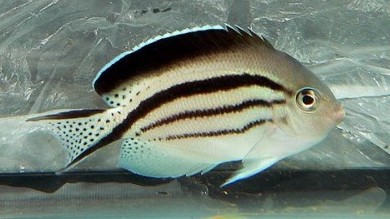
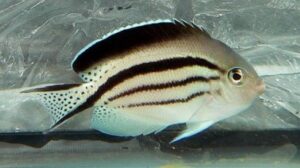
The Lamarck’s Angelfish have the distinction among angelfish of being sexually dimorphic. Both male and female are a silvery-gray with horizontal black stripes from eye to caudal fin. The female’s stripes are bolder with one extending into and covering the length of the caudal fin. In both, the long dorsal fin is black, although larger in the female, and the caudal fin is freckled with black. More easily kept than some other angelfish, the Lamarck’s Angelfish requires a well-maintained in a large tank. They may chase small, docile planktivores such as Anthias, Fairy Wrasses, Flasher Wrasses, and Fire Gobies but will usually ignore other fish, including other Angels. Only one male Lamarck’s Angelfish should be kept per tank. Fish of the genus Genicanthus are the only zooplanktivores among the angelfish.
Diet & nutrition
The Lamarck's angelfish is known for being a planktivore in the wild. However, they can be readily fed with a variety of live, frozen, and prepared formula food in an aquarium setting. Their diet must consist of finely chopped shrimp, fish, squid and mussels, spirulina, diatoms and algae.
Determining sex
Sexual dimorphism is observed for this species of large angelfish, with the male being the larger individual with longer tail fin streamers and a blue spot at the base of their pectoral fin. Females, on the other hand, are smaller and have a wide arcing horizontal stripe that crosses over the caudal peduncle.
Breeding & spawning
Breeding for Lamarck's angelfish has been done succesfully in large display aquarium (~1,300 gallon) which helped encourage spawning for this angelfish.
Lamarck's angelfish are broadcast spawners. They follow a courting behavior where the male and female do a courting 'dance' at the top part of the water column. Spawning usually occurs before sunset when the female extends all her fins as she swims next to the male. The male then goes under the female to nuzzle her belly and then darts downward to release his sperm. The female then turns to her side to release her eggs. External fertilization then occurs.
Diseases
Lamarck's angelfish are susceptible to diseases that are borne within the captive saltwater environment such as Saltwater Ich or White spot Disease and Marine Velvet Disease. They are also vulnerable to viral infections such as Lymphocystis which are small nodules on the fish fins and mouth. This angelfish is also prone to contract parasitic infections such as monogenetic flukes.
Origination
This angelfish is widely distributed in the tropial waters in the Indo-West Pacific. It ranges from the Indo-Malayan region, eastward to Vanuatu, north to Souther Japan, and then southward to the Great Barrier Reef.
Cautions
Placing 2 male Lamarck's angelfish in the tank may initiate sparring between the individuals, resulting in one turning back to female. They are relatively peaceful angelfishes. However, they are known to chase smaller food competitors such as fairy wrasses, flasher wrasses, anthias, tilefish, Chromis damselfish, fire gobies and Creole Wrasses.
Acclimation process
A single Lamarck's angelfish may be kept in a 75 gallon tank while tanks over 100 gallons is recommended when keeping 2 or more individuals. The aquarium must be kept with the following water parameters: 72-81° F, pH 8.0-8.4, sg 1.023-1.025. Water in the tanks must be changed bi-weekly.
All photos
Tap a photo to open the gallery viewer.