
French Angelfish
Pomacanthus paru
Saltwater Fish
Species Group: Angel Large
Family: Pomacanthidae
Log in or create an account to add this species to your tanks.
Water parameters
Temp
76-80 F
Temperature
Maintaining a stable and appropriate temperature is critical for the survival of aquatic life.
pH 7.8 - 8.4 potential of HydrogenMeasuring the acidity or alkalinity of water on a 0–14 scale, where 7 is neutral, 7 is alkaline.
NO3 1-20 ppm NitrateWhile less toxic than ammonia, high nitrate levels (above 40–80 ppm) are important to monitor because they can cause fish stress, stunted growth, and harmful algae blooms.
NO2 <0.0001 ppm NitriteIt is a highly toxic, intermediate compound in the nitrogen cycle produced from broken-down ammonia
PO4 0.01 - 0.1 ppm PhosphateIt is essential for plant development but must be managed, as excess levels trigger nuisance algae blooms and inhibit coral calcification.
NH3 <0.1 ppm AmmoniaIt is the primary killer of aquarium fish, causing gill damage, stress, and death
Ca 380 - 450 ppm CalciumSupporting the growth, skeletal structure, and shell formation of corals, mollusks, crustaceans, and coralline algae
KH 8 - 12 dKH AlkalinityIt acts as a shield, neutralizing acids to prevent dangerous pH "crashes" that can harm fish, corals, and plants.
Mg 1200 - 1400 ppm MagnesiumIt enables coral growth by supporting skeletal formation, assists in metabolic processes, and ensures that calcium is available for corals, clams, and coralline algae.
SG 1.023 - 1.026 SG SalinityEssential for maintaining stable, natural water parameters, proper osmoregulation, and stress-free environments for marine fish and corals
ORP 250 - 400 mV Oxidation-Reduction PotentialA higher positive mV indicates clean, oxygen-rich water with high water quality, while low readings indicate high pollution.
About French Angelfish
General information
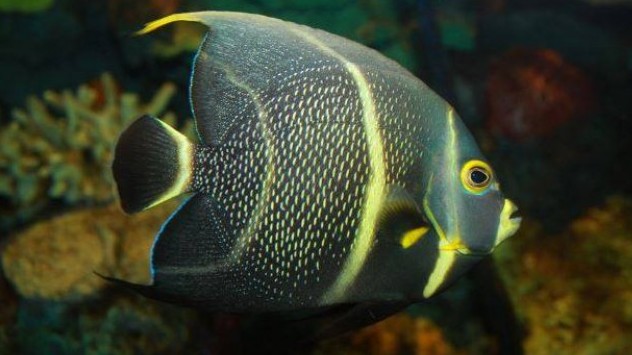
The French Angelfish is one of the more popular angelfish varieties. The face is a pale, dusky-blue with eyes rimmed in yellow and white. The body is a dark, dusky-blue with yellow scale margins giving the French Angelfish a dappled appearance. A yellow smudge highlights the pectoral fin while the gill cover has a yellow rim. A large tank should be provided and include large amounts of live rock for hiding and grazing. Not a good candidate for a reef tank, the French Angelfish has a tendency to nip at sessile invertebrates (soft and stony corals) and clam mantles and also tends to dominate the tank. The Small Juvenile will contain the Juvenile colorations or may be color shifting to a young adult, while the Medium will be a sub-adult, and the Large will be in Adult coloration.
Diet & nutrition
Pomacanthus paru are mainly omnivores feeding primarily on sponges and algae. In the wild they also consume bryozoans, zoanthids, gorgonians, and tunicates. In the tank, juvenile French angelfishes may be fed with a mix of algae and detritus while adult angel should be fed with food mixture containing sponge and vegetable food. Feeding should be done four to five times a day due to their constant grazing nature in the wild.
Breeding & spawning
There are no physical characteristics differentiating male from female French angels, however, as adults they are seen swimming in pairs. There have been records of successfully breeding iin aquariums and rearing young developed from hormone-induced spawning. Just like other angelfishes, the French angelfish spawn their gametes externally into the water column at dusk.
Diseases
Prone to diseases in captive saltwater environments if tank are not kept in best shape. Some diseases include White spot disease and marine velvet. These fishes are also prone to parasites if kept in tanks with live rocks.
Origination
French angelfish are found in the western Atlantic Ocean from Florida to Brazil. juvIts range also includes the Gulf of Mexico and the Caribbean Sea, including the Antilles.
Cautions
Juvenile French angelfish exhibit cleaning behavior and declines when the fish reaches a size of 5-7 cm. The French angels arerelatively peaceful angelfishes and can be kept in a community aquarium. Caution should be done when adding in tanks with sedentary fish such as frogfish, seahorses or scorpionfish since the angelfish will likely pick at it if it resembles the reef rocks and substrate. It may also pick on other invertebrates like clams, oysters, and scallops resulting in them to close and dry up.
Acclimation process
They should be kept in tanks with an ideal size of 250-300 gallons provided with open areas to swim around and live rocks to forage and hide in while young. Light mimicing the natural sunlight condition of the reef they come from should be incorporated in the tanks to help process vitamins they consume and to avoid blindness and other deficiencies.
All photos
Tap a photo to open the gallery viewer.