
Fireball Angelfish
Centropyge aurantonotus
Saltwater Fish
Species Group: Angel Dwarf
Family: Pomancanthidae
Log in or create an account to add this species to your tanks.
Water parameters
Temp
76-80 F
Temperature
Maintaining a stable and appropriate temperature is critical for the survival of aquatic life.
pH 7.8 - 8.4 potential of HydrogenMeasuring the acidity or alkalinity of water on a 0–14 scale, where 7 is neutral, 7 is alkaline.
NO3 1-20 ppm NitrateWhile less toxic than ammonia, high nitrate levels (above 40–80 ppm) are important to monitor because they can cause fish stress, stunted growth, and harmful algae blooms.
NO2 <0.0001 ppm NitriteIt is a highly toxic, intermediate compound in the nitrogen cycle produced from broken-down ammonia
PO4 0.01 - 0.1 ppm PhosphateIt is essential for plant development but must be managed, as excess levels trigger nuisance algae blooms and inhibit coral calcification.
NH3 <0.1 ppm AmmoniaIt is the primary killer of aquarium fish, causing gill damage, stress, and death
Ca 380 - 450 ppm CalciumSupporting the growth, skeletal structure, and shell formation of corals, mollusks, crustaceans, and coralline algae
KH 8 - 12 dKH AlkalinityIt acts as a shield, neutralizing acids to prevent dangerous pH "crashes" that can harm fish, corals, and plants.
Mg 1200 - 1400 ppm MagnesiumIt enables coral growth by supporting skeletal formation, assists in metabolic processes, and ensures that calcium is available for corals, clams, and coralline algae.
SG 1.023 - 1.026 SG SalinityEssential for maintaining stable, natural water parameters, proper osmoregulation, and stress-free environments for marine fish and corals
ORP 250 - 400 mV Oxidation-Reduction PotentialA higher positive mV indicates clean, oxygen-rich water with high water quality, while low readings indicate high pollution.
About Fireball Angelfish
General information
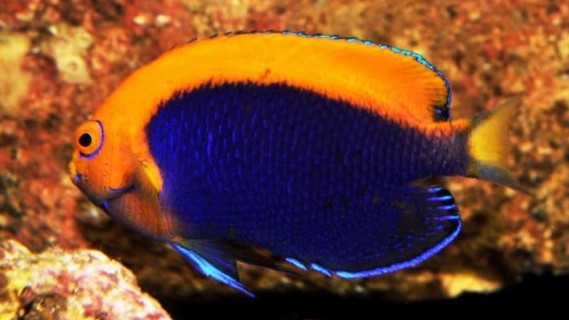
Common across patches of isolated staghorn coral Acropora cervicornis in the southern Carribean and in the coasts of Brazil. The majority of its oval-shaped body is deep blue, with yellow coloration above, and it can reach up to a length of 6 cm. It is often confused with the Orangeback Angelfish (Centropyge acanthops) but in the latter the yellow to orange coloration extends to cover the entire back. The flameback angelfish has a short snout and small mouth.Its dorsal fin has about 15 spines and 16 soft rays. Its anal fins consist of about 17 soft rays and 3 spines. Its eyes have a narrow blue ring around it. Juvenile flameback pygmy angelfish have the same body colour except that the yellow-orange coloration spreads further back. It's a non-migratory species found in depth ranges of 12 to 200 m.
Diet & nutrition
The fireball angelfish is an omnivorous marine angelfish that feeds mainly on algae and sponges in the wild. In captivity, diet should include Spirulina, marine algae, high-quality angelfish preparations, mysis or frozen shrimp, and other high-quality meaty foods. Feeding in small amounts should be done 3 times per day.
Determining sex
It is not possible to visually determine the sex of the Fireball Angelfish based on their coloration. However, since these angels are protygenous hermaphrodites, individuals that are usually larger are deemed to be male.
Breeding & spawning
This species has not been bred in captivity. In the wild, the male fireball angelfish approaches the female and perform courting gestures. The male then continues by encircling the female and increases his lateral curved body surface with its unpaired fins giving a complete fan-like erection, his paired fins then flutter, and his body will quiver and goes pale. When a female finally shows willingness for spawning, spawning partners line up and their bodies quiver as the male releases his gametes. The male gametes are ejaculated into the egg cluster when the male pushes his snout against her ovarian area. External fertilization then occurs, and about 6 hours after spawning fertile eggs float to the water's surface.
Diseases
Angelfishes such as the Blue Spotted Angelfish might be able to contract common bacterial diseases such as Cotton wool disease, Vibrio bacterial disease, and Fish tubercolosis. Cotton wool disease is exhibited as an expanding translucent layer that eats away on the skin. Vibrio Bacterial disease on the other hand are exhibited by Dropsy, Popeye, Bleeding or Red Streaks on the skin. Lastly, Fish T.B. usually shows up as a loss of color and swelling of the body. It can also display blood streaks and blood spots anywhere in the body. Aside from bacterial diseases, angelfishes my be affected by common reef scourges such as the Crypt or White Spot Diseases and Velvet Disease. Tiny white spots on the skin of the fish is one of the tell-tale sign of infection of the Crypt while dusty golden film on the skin or the eyes of the angelfish will detect the presence of Velvet Disease.
Origination
Centropyge aurantanota or Fireball angelfish are widely distributed in the Western Atlantic. It can be found in the Lesser Antilles, Curacao, Venezuela on the northern coast of South America and to south of Brazil.
Cautions
The Fireball Angelfish can damage reef systems since it is prone to nip at stony and soft corals, sessile invertebrates, and clam mantles. This species can be extremely aggressive towards other fish. It requires a 20 gallon or larger tank with multiple hiding places and live rock for grazing and to avoid being territorial and agressive with other fish in the tank.
Acclimation process
In adding fishes to the tank, the least aggressive are introduced first. When adding similar sized Angelfish it works best if they are introduced simultaneously. Fireball angelfish prefer reef tanks with plenty of live rock structures to fish only tanks.
All photos
Tap a photo to open the gallery viewer.