
Black Nox Angelfish
Centropyge nox
Saltwater Fish
Species Group: Angel Dwarf
Family: Pomacanthidae
Log in or create an account to add this species to your tanks.
Water parameters
Temp
76-80 F
Temperature
Maintaining a stable and appropriate temperature is critical for the survival of aquatic life.
pH 7.8 - 8.4 potential of HydrogenMeasuring the acidity or alkalinity of water on a 0–14 scale, where 7 is neutral, 7 is alkaline.
NO3 1-20 ppm NitrateWhile less toxic than ammonia, high nitrate levels (above 40–80 ppm) are important to monitor because they can cause fish stress, stunted growth, and harmful algae blooms.
NO2 <0.0001 ppm NitriteIt is a highly toxic, intermediate compound in the nitrogen cycle produced from broken-down ammonia
PO4 0.01 - 0.1 ppm PhosphateIt is essential for plant development but must be managed, as excess levels trigger nuisance algae blooms and inhibit coral calcification.
NH3 <0.1 ppm AmmoniaIt is the primary killer of aquarium fish, causing gill damage, stress, and death
Ca 380 - 450 ppm CalciumSupporting the growth, skeletal structure, and shell formation of corals, mollusks, crustaceans, and coralline algae
KH 8 - 12 dKH AlkalinityIt acts as a shield, neutralizing acids to prevent dangerous pH "crashes" that can harm fish, corals, and plants.
Mg 1200 - 1400 ppm MagnesiumIt enables coral growth by supporting skeletal formation, assists in metabolic processes, and ensures that calcium is available for corals, clams, and coralline algae.
SG 1.023 - 1.026 SG SalinityEssential for maintaining stable, natural water parameters, proper osmoregulation, and stress-free environments for marine fish and corals
ORP 250 - 400 mV Oxidation-Reduction PotentialA higher positive mV indicates clean, oxygen-rich water with high water quality, while low readings indicate high pollution.
About Black Nox Angelfish
General information
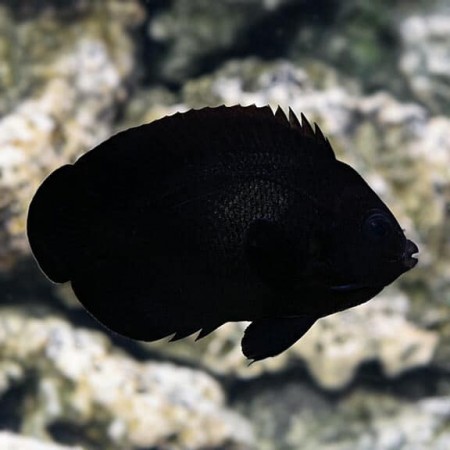
The Black Nox Angelfish is uniformly black over its entire body. The Black Nox Angelfish should be the only dwarf angelfish in the tank. It is not a good reef dweller and may eat soft coral polyps, clam mantles, and zoanthids.
Diet & nutrition
Midnight Angelfishes are omnivores like the other species of angelfishes. It mostly feeds on algae. Tank feeding should include spirulina algae, marine algae, mysis shrimp with other fleshy organism such as brine or krill, and live rocks with algae for grazing. It should be fed 2 to 3 times a day to maintain a healthy immune system.
Determining sex
Centropyge species like the Black Nox Angelfish are protogynous fishes. They start their life cycle as unsexed individuals and begin adult life as females. Differentiation in sex (female to male) will occur to the larger and more dominant individual within a group. Therefore, male Black Nox Angelfishes are usually bigger in size than the female counterpart, and has no distinguishable color differences between gender.
Breeding & spawning
Captive breeding for this species has not been done yet. However, in the wild this species are usually seen together singly or in pairs. The male will visit the home of the females at dusk to mate and it may spawn with one or multiple females per night. This species spawn their gametes (eggs and sperm) externally for fertilization. The fertilized eggs will not be protected by either parent. Once spawning is done, the male will then move on to its next partner.
Diseases
C. nox is prone to parasitic and protozoan diseases such as White Spot Disease or Crypt (Cryptocaryon irritans), which is exhibited as a constant scratching and white dots all over the body, and Velvet Disease (Oodinium ocellatum) which gives a peppery coating on the fish's body.
It can also be affected by Vibrio bacteria, which is a very fast acting bacteria that can kill the angelfish within days. It usually starts as an internal infection followed by Dropsy, Popeye, Bleeding or Red Streaks on the skin.
Black Nox angelfishes can also be affected by physical ailments resulting from incompatible water conditions and tankmates. When very stressed, the angelfishes tend to hover in the upper corner of the tank.
Origination
Centropyge nox are widely distributed coral-rich areas of the outer reefs in the western Pacific from the Ryukus Island in Japan to Indonesia, the Solomon Islands, the Great Barrier Reef, New Caledonia and Micronesia.
Cautions
Black Nox angelfishes are considered to be one of the less aggressive angelfishes. In natural environments it can sometimes be seen in pairs and harems, but in the confinements of the aquarium it should be noted that it is the only angelfish present in the tank, unless a mated pair is acquired and/or other peaceful Centropyge are present.
Tankmates of C. nox should be peaceful to semi-agressive in nature and not a direct competitor for food. It should also be noted that Black Nox Angelfishes can be found nipping on soft coral polyps, clam mantles, and zoanthids but does not bother invertebrates such as shrimps, snails, and crabs if well fed.
Acclimation process
Black Nox Angelfish should be kept in a reef-aquarium tank or fish only tank with a size of 50 to 100 gallons if intending to keep 1 or 2 individuals. The fish takes a minimum of 30 minutes to 3 hours to acclimatize in its new tank condition. Since it is an essentialy shy species, it should be placed in a spacious mature reef-aquarium system provided with plenty of live rocks and hiding places. When adding into a well-established reef aquarium, it should be added last and are introduced simultaneously if adding more than 1 individual.
All photos
Tap a photo to open the gallery viewer.