
Emperor Angelfish
Pomacanthus imperator
Saltwater Fish
Species Group: Angel Large
Family: Pomacanthidae
Log in or create an account to add this species to your tanks.
Water parameters
Temp
76-80 F
Temperature
Maintaining a stable and appropriate temperature is critical for the survival of aquatic life.
pH 7.8 - 8.4 potential of HydrogenMeasuring the acidity or alkalinity of water on a 0–14 scale, where 7 is neutral, 7 is alkaline.
NO3 1-20 ppm NitrateWhile less toxic than ammonia, high nitrate levels (above 40–80 ppm) are important to monitor because they can cause fish stress, stunted growth, and harmful algae blooms.
NO2 <0.0001 ppm NitriteIt is a highly toxic, intermediate compound in the nitrogen cycle produced from broken-down ammonia
PO4 0.01 - 0.1 ppm PhosphateIt is essential for plant development but must be managed, as excess levels trigger nuisance algae blooms and inhibit coral calcification.
NH3 <0.1 ppm AmmoniaIt is the primary killer of aquarium fish, causing gill damage, stress, and death
Ca 380 - 450 ppm CalciumSupporting the growth, skeletal structure, and shell formation of corals, mollusks, crustaceans, and coralline algae
KH 8 - 12 dKH AlkalinityIt acts as a shield, neutralizing acids to prevent dangerous pH "crashes" that can harm fish, corals, and plants.
Mg 1200 - 1400 ppm MagnesiumIt enables coral growth by supporting skeletal formation, assists in metabolic processes, and ensures that calcium is available for corals, clams, and coralline algae.
SG 1.023 - 1.026 SG SalinityEssential for maintaining stable, natural water parameters, proper osmoregulation, and stress-free environments for marine fish and corals
ORP 250 - 400 mV Oxidation-Reduction PotentialA higher positive mV indicates clean, oxygen-rich water with high water quality, while low readings indicate high pollution.
About Emperor Angelfish
General information
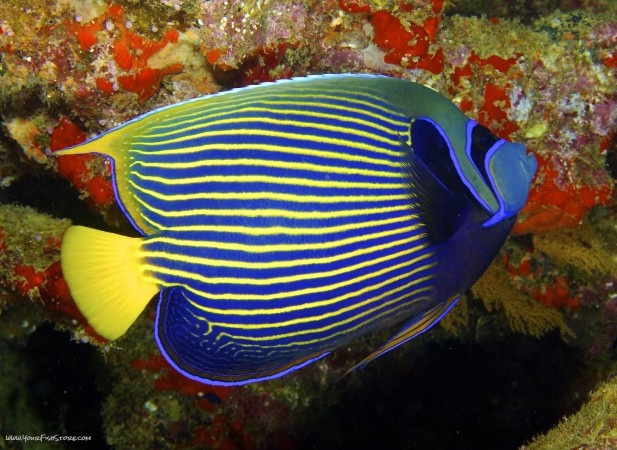
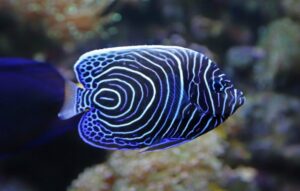
Has a bold, blue body covered with bright yellow horizontal stripes culminating in a bright yellow to orange caudal fin. A striking blue-black mask covers the eyes and a similarly-colored vertical band extends from the pectoral fin two-thirds of the way up the body. This band is highlighted in a sapphire-blue in front, and bright yellow, caudally. The mouth is white. The juvenile is black with circular white and blue stripes starting at the tail. Although sought after for its colors, in captivity, the adult coloration may not be as striking or brilliant. The changing angelfish will vary in coloration and pattern as it transforms from juvenile to the adult coloration.
Diet & nutrition
Emperor angelfish are omnivorous, feeding mainly on sponges, tunicates, and algae. It also feeds on other encrusting organism such as hydroids and bryozoans. In tank conditions, it is best if the prepared food contains sponge and tunicate materials with additional meaty food like mussels, shrimp, squid, and spinach.
Determining sex
Sexual orientation of the emperor angelfish can be distinguished based on their sizes and coloration. Male individuals tend to be larger and have a darker blue anterior to and below the eye bar, female individuals are smaller and have a more muted color (light blue-grey).
Breeding & spawning
Breeding in home tanks has not yet been done for the Emperor Angelfish, however it is possible to breed and raise this species in larger tanks.
Courtship for this species usually occurs at dusk, this then progresses to an ascent to the water column by the males followed by females which eventually lead to the release of gametes in the water column for external fertilization. During courtship the male will trail behind the female positioning his snout to near the female's abdomen.
Diseases
Prone to White Spot Disease and Velvet Disease which causes blotchy coloration on the dark skin areas. It is also prone to Head an Lateral Line Erosion (HLLE) which causes a disfigurement on the fish.
Origination
It is widely distributed in the Indo-Pacific region with the exception of the Easter Island, Rapa and the Marquesan Islands. It ranges from the Red Sea and East Africa to the Hawaiian, Line and Tuamoto islands, north to southern Japan and the Ogasawara Islands, south to the Great Barrier Reef, New Caledonia, and the Austral Islands.
Cautions
When threatened, the Emeperor fish may make grunting noises and turn on its side and hover horizontally just above the bottom. They are semi-aggressive but can be aggressive to other angelfish that are of the same shape, size, and feeding habit.
Always introduce a juvenile Emperor Angelfish as the last fish to the tank to prevent any territorial behavior.
Acclimation process
It needs a stable and mature environment, at least 6 months old, with a minimum of 125 gallons.
Articles


All photos
Tap a photo to open the gallery viewer.