
Giant Cup Mushroom
Amplexidiscus spp
Saltwater Coral
Species Group: Mushroom Amplexidiscus
Family: Discosomatidae
Log in or create an account to add this species to your tanks.
Water parameters
Temp
76-80 F
Temperature
Maintaining a stable and appropriate temperature is critical for the survival of aquatic life.
pH 7.8 - 8.4 potential of HydrogenMeasuring the acidity or alkalinity of water on a 0–14 scale, where 7 is neutral, 7 is alkaline.
NO3 1-20 ppm NitrateWhile less toxic than ammonia, high nitrate levels (above 40–80 ppm) are important to monitor because they can cause fish stress, stunted growth, and harmful algae blooms.
NO2 <0.0001 ppm NitriteIt is a highly toxic, intermediate compound in the nitrogen cycle produced from broken-down ammonia
PO4 0.01 - 0.1 ppm PhosphateIt is essential for plant development but must be managed, as excess levels trigger nuisance algae blooms and inhibit coral calcification.
NH3 <0.1 ppm AmmoniaIt is the primary killer of aquarium fish, causing gill damage, stress, and death
Ca 380 - 450 ppm CalciumSupporting the growth, skeletal structure, and shell formation of corals, mollusks, crustaceans, and coralline algae
KH 8 - 12 dKH AlkalinityIt acts as a shield, neutralizing acids to prevent dangerous pH "crashes" that can harm fish, corals, and plants.
Mg 1200 - 1400 ppm MagnesiumIt enables coral growth by supporting skeletal formation, assists in metabolic processes, and ensures that calcium is available for corals, clams, and coralline algae.
SG 1.023 - 1.026 SG SalinityEssential for maintaining stable, natural water parameters, proper osmoregulation, and stress-free environments for marine fish and corals
ORP 250 - 400 mV Oxidation-Reduction PotentialA higher positive mV indicates clean, oxygen-rich water with high water quality, while low readings indicate high pollution.
About Giant Cup Mushroom
General information
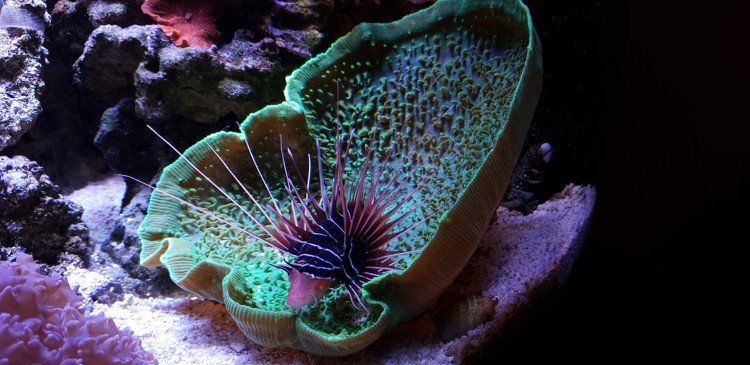
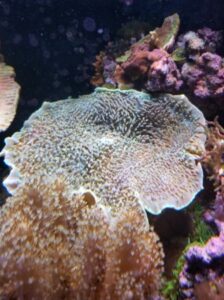
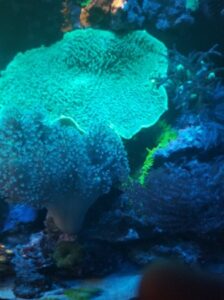
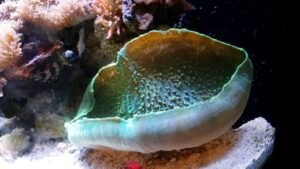
The Giant Cup Mushroom outer edge is almost translucent and does not have verrucae. They commonly reach diameters of 8-10″ in an aquarium but can reach up to 18″. They can change the shape of their disk within a short period.
The Giant Cup Mushroom does excellent in a predatory reef tank with large fish which will not pick on the mushroom. Some caution should be taken if you have smaller fish or invertebrates in the same aquarium. The Amplexidiscus species is known to eat fish smaller than 6″ long. Small fish should not be kept with this species, especially fish that like to perch on corals like blennies, clownfish, gobbies, dragonets, hawkfish or slow moving fish. These fish and week fish due to illness are likely to fall victim to the Giant Cup Mushroom.
They are sometimes confused with Carpet anemones by hobbyist and Clownfish. When Clownfish think they found a new host, they are quickly stung, and the disk quickly closes to consume them.
The Giant Cup Mushroom will sometimes close up only leaving a small hole open which some fish may think is a cave and the moment they enter the hole they are quickly stung and the disk closes up.
Once contact with the mushroom is made, its stinging cells immobilize the prey, and then it closes up within 3 seconds.
Suggested water change maintenance should include 10% weekly water change or 20% bi-weekly water changes.
Diet & nutrition
The Giant Cup Mushroom needs moderate light and also needs to be feed if they do not get enough food they can detach and start floating around the tank to try to attach somewhere else to try to get a better food source. If this happens, you can place them back where you had them and try to feed more frequently.
If the Giant Cup Mushroom spits the food out, then there could be an issue with the amount of light that it is getting or your water quality.
When feeding, the mouth of the Giant Cup Mushroom remains closed until the entire oral disc is closed. The mouth then opens and consumes the prey and will close again before opening up again.
They enjoy feeding at night, so right after lights out. If you want them to multiply quickly feed them as often as they will close up around the food. Interestingly, their feeding response will not happen with any touch, but only the touch of prey, indicating a chemical reaction is needed, not just any touch from your finger or an object.
Breeding & spawning
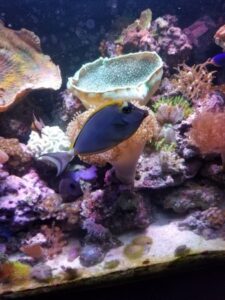
The Giant Cup Mushroom are naturally found in shallow waters there for they can tolerate higher intensity lights. This is one of the mushrooms that can be placed on the top portion of your tank but also does well in the middle of the tank.
The shallow waters where they are also found experience shifts between low flow and turbulent waters. So this mushroom can even tolerate higher flows but does need a break from the high flows to keep it healthy.
Origination
The Amplexidiscus Genus are found in shallow waters that shifts between low flow and turbulent waters, in areas of subtidal coral reef lagoons in the Indo-Pacific. They are found alone, and at times in clusters. They like to attach them self on live rock or dead coral.
Cautions
The Giant Cup Mushroom is an aggressive mushroom that will eat small fish (6" long and smaller). Proper spacing must be observed in relation to other coral species in the tank to prevent it from stinging them.
Acclimation process
The Giant Cup Mushroom is a marine species. Therefore, salinity must be maintained thoroughly at 1.023 to 1.025 specific gravity.
All photos
Tap a photo to open the gallery viewer.